
Link building within a niche search industry is never easy. With more competition for fewer valuable placements, creating a strategic campaign that outpaces your competitors is crucial.
When it comes to link building for financial services, the bar rises even higher. The average cost to place a do-follow fintech link in 2026 is up to £1500+, making the fintech sector one of the most expensive search niches to master.
Fintech link building requires a strategic approach for each and every placement, requiring SEO teams to get creative when it comes to acquiring resource links, building linkable assets, and creating link-worthy content.
This guide aims to delve deeper into the world of fintech link building, uncover the hardships, and equip your SEO team with the best tools and strategies to boost your backlink profile in 2026 and beyond.
What is Fintech Link Building?
Fintech link building is the process of acquiring backlinks from domains within the financial services search niche.
Whether you’re building links on external financial websites and blogs, government resource pages, or news outlets of your own, the key here is to signal to the search engine that your financial products are trustworthy and valuable to your target search audience.
Link building not only helps reinforce your brand’s credibility and expertise, but depending on where you acquire backlinks, these can also act as ‘votes of confidence’ from key players within the search niche that are frequented by qualifiable leads.
Is Fintech Link Building Harder Than Traditional Link Building?
The short answer is yes. Fintech link building is not only extremely competitive and costly, but link placements come under regular scrutiny, especially when the link promotes a financial product.
Here are some of the key reasons why fintech link building often takes a different approach to traditional strategies:
The Cost
The cost of placing a fintech link is the highest among all niches. According to Authority Hacker’s 2025 report, which surveyed 743 link builders, the median cost per fintech link on a low DR30-DR50 stood at $361, while placements on websites with 70+ DR skyrocketed to $1500+.
This is in comparison to links placed within the ecommerce search niche ($210) and B2B SaaS ($245). As you can see here, the price of a fintech link immediately rattles the budget.
The question is why? Fintech link building operates in a heavily regulated, high-stakes, and hyper-lucrative market.
This means that when a consumer searches for a financial product, their intent most commonly translates directly to the price, which always drives up competitive demand.
Think about it this way: if visibility drives engagement and customer acquisition is the key driver of profits, it’s no surprise fintech brands are willing to pay those massive link-building premiums for top-tier placements.
It’s therefore no surprise that key publications within the search niche raise their prices for fintech link insertion, so your SEO team must be prepared to battle rising costs too if your company want to beat its closest competitor.
YMYL Classification
Under Google’s Search Quality Radar guidelines, any content that could affect a consumer’s financial well-being is instantly classed as YMYL (Your Money or Your Life).
This covers just about every piece of content a fintech link may be placed in, from personal finance advice articles to tax guidance, insurance and crypto blog posts.
A YMYL tag can make it harder for content to rank, especially if they accept links from low-trust sources. This means that key finance publications are looking for high credentials, established visibility online, and strong trust signals when accepting link insertions within their content.
This instantly raises the game for fintech link builders. If publishers are more picky, your SEO team need to be prepared to create a perfect pitch. This includes finding hyper-relevant sites, working on other aspects of your brand visibility and angling outreach to help convince editors that your placement is beneficial to their SEO as well as yours.
Compliance Scrutiny
Another key consideration all fintech link builders must be aware of is compliance scrutiny. In the UK search market, the FCA’s financial promotions regime applies to any content that encourages consumers to engage in investment activity.
Therefore, whether you’re placing affiliate links or creating a full guest post for a fintech publication. You must refrain from financial promotion to avoid compliance penalties that dwarf the SEO upside.
These rules are also similar across the US, SEC and FINRA, so it’s important to do your homework before you begin your campaign.
Key publishers that you reach out to, including established trade media, broadsheet press, government material and educational blogs, will also have their own internal compliance team ready to check and reject any placements, guest posts and niche edits that breach these standards.
Why Do Fintech Links Matter as a Financial Service?
While they are much harder to place, fintech links drive serious SEO success for your financial service.
Link building in a financial search market is the best way to improve search visibility and drive customer acquisitions.
In a sector where trust and accuracy matter more than ever before, gaining as many ‘trust signals’ as possible from key authoritative domains not only strengthens your credibility with the search engine but also helps guide customers directly to your checkout.
Here are some of the key benefits of link building as a financial service:
- Enhanced Search Visibility: It’s no secret that fintech links are a key ranking driver, especially when you’re trying to win high-intent searches against well-performing banks, loan companies and financial services. Fintech link building can help your company rank for competitive keywords, support stability for your evergreen rates and fees pages and help strengthen your performance both in SERPs and generate engine results.
- Drives More Traffic: Your key targets already have financial intent. The challenge is driving them to your product pages. Financial link building can help boost your visibility across search, AIO and within popular educational content. This visibility improves engagement alone, but links placed within high-traffic publications encourage qualified leads to navigate to your domain.
- Builds Credibility in a YMYL Space: YMYL means stricter quality standards. If you have multiple backlinks from highly accredited sources in the financial services search niche, this helps reinforce your credibility as a fintech brand. Essentially, you’re building an association with the most trusted industry entities. This supports E-E-A-T, especially if your likes are paired with high-quality content and helpful tools such as financial calculators. Every step you take to reinforce your credibility in the search space encourages the search engine to feature your brand, products and services in high-intent searches and generative overviews.
- Improves Local SEO: If you can also score local backlinks as a financial service, you instantly boost your location-based search visibility. Placing fintech links on local news publications, community blogs, and chambers of commerce can help your brand earn local trust signals that attract your target referrals. This is especially important if your company has a physical location that local customers can interact with.
7 Fintech Link Building Strategies for 2026
Now that we’ve covered some of the key benefits of fintech link building, let’s take a closer look at how to build fintech links that drive results.
Whether you’re a seasoned link-building professional or a fintech link-building beginner, here are our top strategies for 2026 that you’ll want to add to your next link-building campaign.
Create Financial Tools & Calculators
We’re going to kick the list off by talking about linkable assets. A linkable asset is a high-value piece of content that naturally attracts links organically from top publications.
For this, we’re talking about tools, studies and templates that can be easily shared and embedded within powerful evergreen content and used as a reference by target publishers.
For the financial services industry, your linkable assets are most likely to be educational investment guides, interactive tools such as mortgage calculators and payoff planners that can be linked out to in fresh content and how-to guides.
Educational Content
Financial educational content always attracts links. If you can create niche-specific content that actively answers a common question or solves a customer pain point, you instantly make a linkable asset.
However, the key here is to stay neutral. If you’re guaranteeing outcomes, you must use disclaimers, especially if you want to stay compliant. Our advice is to create evergreen linkable resources. These tend to focus less on trends and topical discussion and more on helping target customers long-term with their investing habits.
Some examples of financial educational content include:
- Financial Literacy Guides: these are your basic budgeting guides, how-tos and overviews of large investing, credit and loan topics that need to be accessed and referenced regularly.
- Glossaries: Definition pages for complex financial terms, tech and strategies always perform well as a linkable asset.
- Regulatory Explainers: These are your compliance checklists, loan eligibility tools and any other resources consumers may refer to before making a key financial decision.
Interactive Financial Tools
For financial services, one of the best tangible assets you can create is a helpful fintech tool, such as mortgage calculators, debt payoff planners and tax estimators that consumers can use to complete everyday financial tasks.
These types of tools always attract links from industry bloggers, publishers and even news outlets, often being published within evergreen content and resource pages that are often frequented by your target leads.
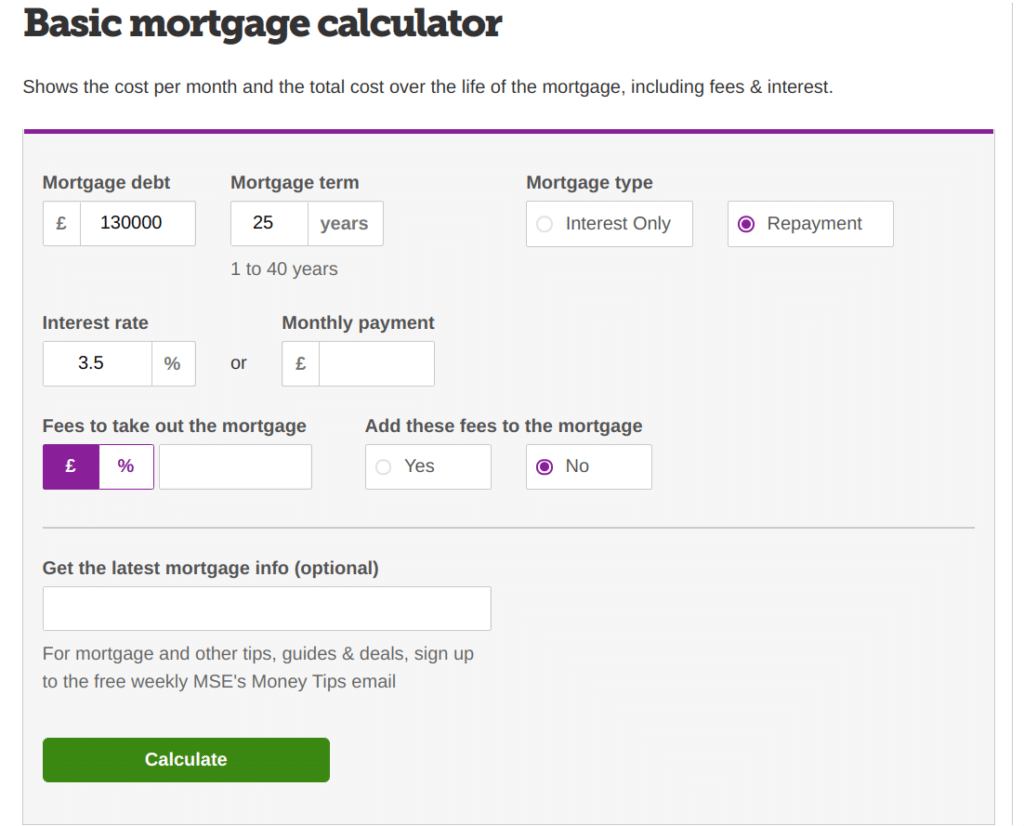
(Image Source: HouseTree)
Here is where specificity wins. Create tools that naturally advertise your paid products. For example, if you’re a personal finance management service, building a tax estimator tool instantly attracts self-employed leads looking to manage their finances independently.
Resource Page Link Building
While you may have created helpful resources for your search niche, this does not always guarantee that your brand will be linked to and mentioned by your target publications.
Resource page link building is the process of placing your fintech links in other established financial tools and guides that appear on high-traffic, authoritative websites within your search industry.
These are often .edu sites, nonprofit pages and government resources that all pass strict compliance codes, and are trusted in a YMYL space by the search engine. If you can score a fintech link here, your brand is instantly associated with other credible publications that hold a great deal of authority.
To discover the best resource pages for fintech link insertion, start by using Google search operators to discover key spots for insertion:
Here are some of the queries you can try:
- site:.edu “financial resources” + [your topic]
- “useful links” + “personal finance”
- “recommended resources” + “financial planning”
- “helpful tools” + “financial advisor”

Once you’ve selected the resource posts that are most relevant to your financial service, it’s time to pitch your product or resource as an addition.
For the most success, we’re searching for listicles here with product roundups and recommendations that your brand can slot within.
Another easy insertion could come from a helpful tools page. For example, if you stumble upon a roundup of the ‘Best Mortgage Calculators To Use In 2026’, this is a great opportunity to submit your free tool to add to the list.
In this case, your goal is to score an .edu link from a business school resource page or a .gov link from a state financial literacy portal. For a financial service looking to build SERP authority, these are the most powerful fintech links you can earn.
Find Relevant Fintech Sites and Write for Them
An obvious, yet highly effective fintech link-building strategy is guest posting. If you can place a guest post in a reputable fintech publication such as Forbes or Bloomberg, you attract positive attention from search engine crawlers.
Guest posting is the process of creating topical, helpful or thought leadership content for other publications within your search industry. Guest posts are a great opportunity to discuss topics that organically align with your fintech brand and products.
Whether you create a helpful ‘how-to’ guide or provide a new angle on a trending financial topic, the key here is to create a natural space for a link placement within the article.
How to Pitch a Financial Guest Post
Before creating your content, it’s best to identify your target publications. Look for high-authority blogs, news outlets, and industry resources that have accepted guest posts from competitors and other unsolicited submissions.
Refer to this checklist before you begin crafting content:
- Is the domain authoritative? Does the website have a high DA/DR, rising or stable traffic?
- Does the website accept guest posts? Look for previous guest post submissions or a ‘write for us’ page?
- Does the publication have strict guest posting guidelines? Do posts have to be over a certain word length? Does the publisher only accept no-follow links?
Once you’ve shortlisted a number of websites, we’d advise pitching targeted titles to the editor before crafting your guest post.
The key here is to personalise your outreach approach. Deliver a pitch that advertises value to the publication and its readers. Discussing the problem that your guest post solves or answers is a great place to start.
Here’s a pitch template to get you started:

Your pitch should immediately offer the editor value. This usually comes in the form of a new angle on a traffic-driving topic, helpful evergreen content from a thought leader, or an exclusive stats piece that can attract links from other high-performing domains.
Your pitch shouldn’t read as an advert for your company or products. Striking a balance between informative and promotional is the best way to secure a powerful placement.
Stay Active on /r/fintech/
Online communities and forums are often missed by fintech link builders. While they are not the most common space for fintech link building, they have serious untapped potential.
Forums like the subreddit /r/fintech is a great place to start. This forum space on Reddit is constantly inundated with financial planning questions, service breakdowns and customer-paid points, all conversations that your brand can be a part of.
Better still, forum posts like this often linger at the top of SERPs for years even after questions are answered.
If you’re constantly seeing Reddit pages at the top of SERPs for your target keywords, why not engage with these question and answer pages to provide helpful commentary and answers alongside links to your website?
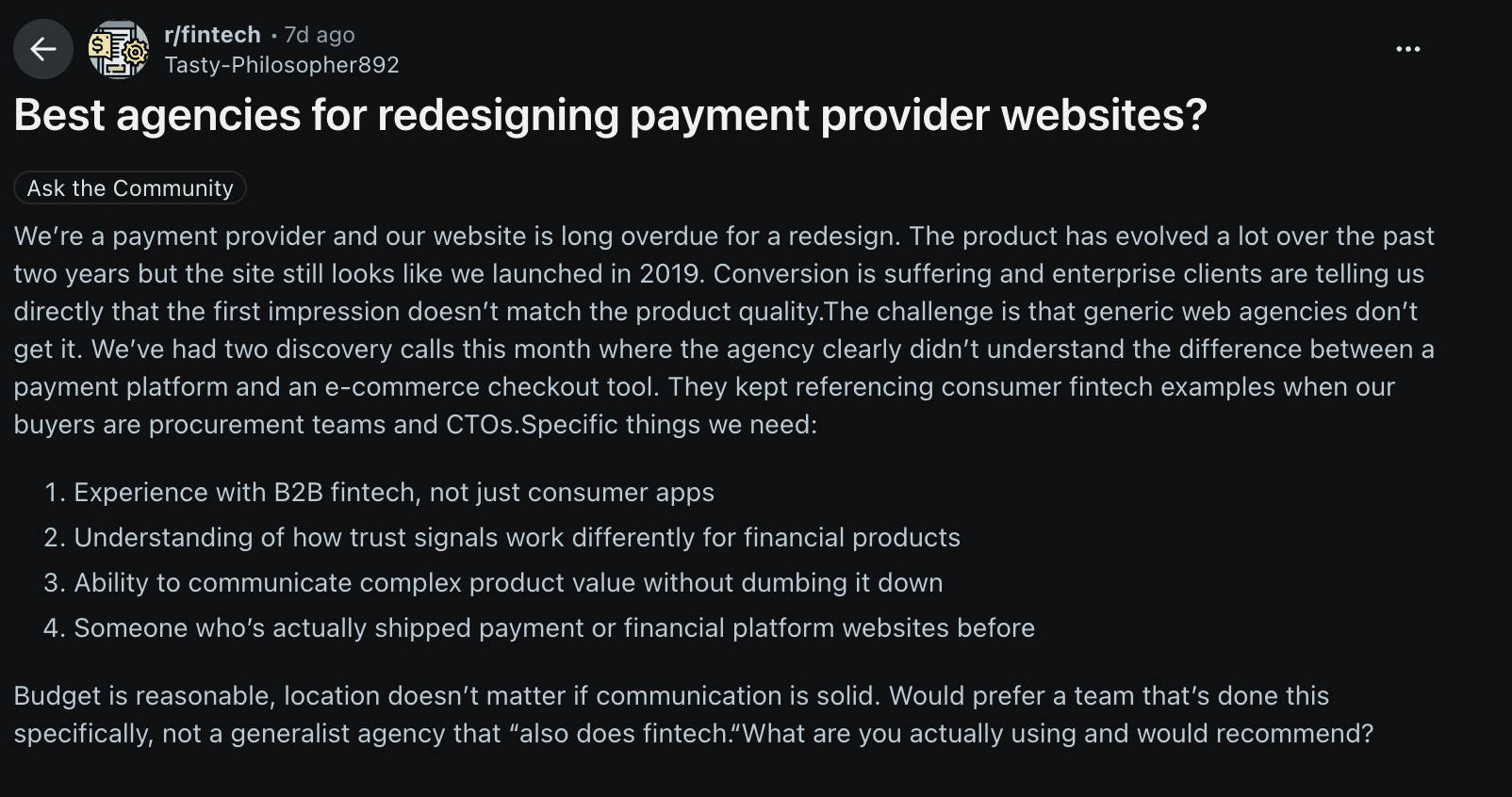
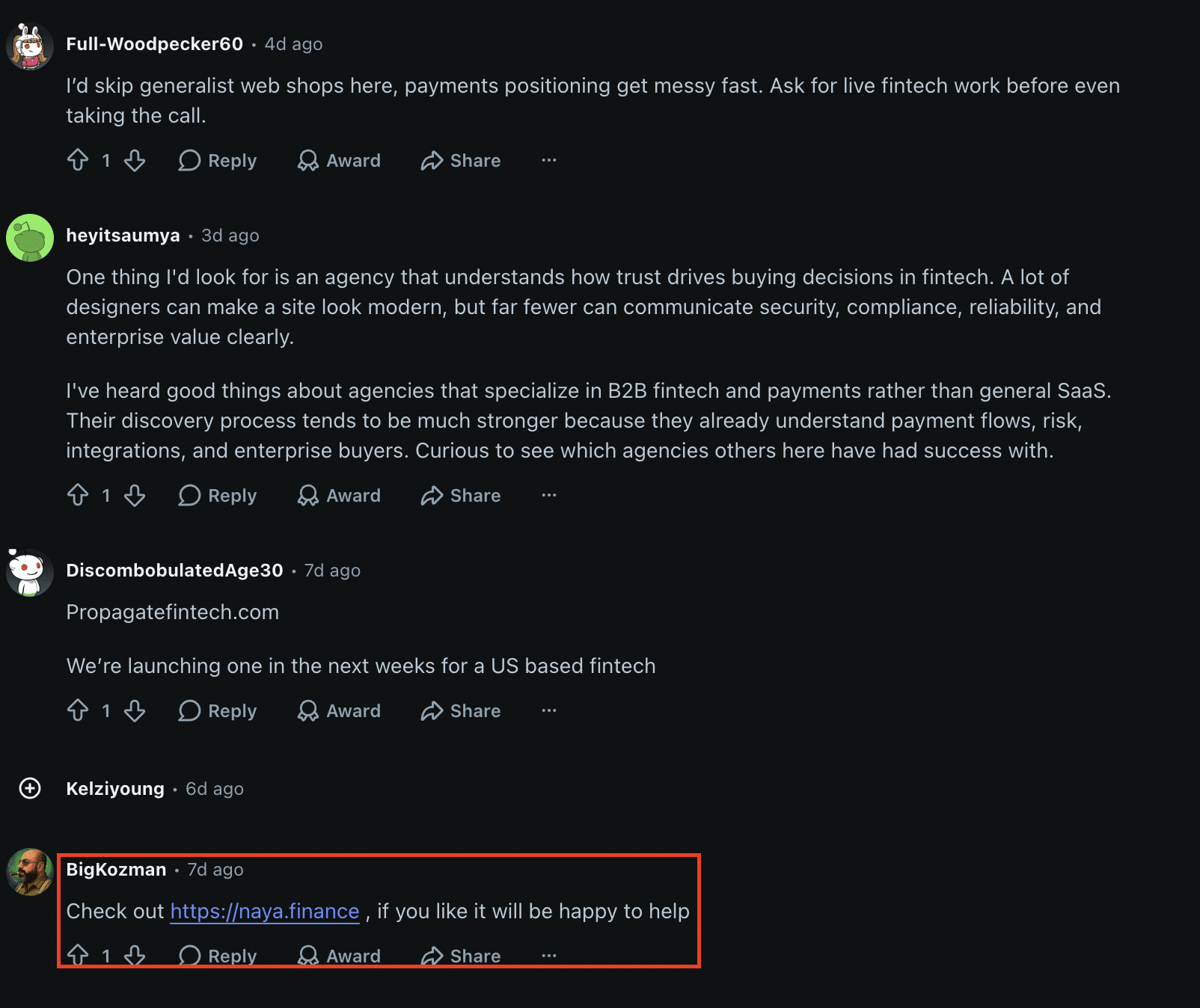
Remember, you’re also connecting directly in this space with potential customers who are looking to solve a pain point.
This is an opportunity for your brand to establish itself as a helpful source, provide industry knowledge and organically link readers to products that could help resolve their problem.
Consider Thought Leadership and Digital PR
Did you know that 70% of high-authority fintech links earned by top fintech sites are driven by digital PR and thought leadership?
In a search industry where journalists are constantly looking for expert commentary, sources and stats, digital PR could help your brand earn more media coverage from top industry publications.
Whether you outsource your digital PR strategy or create room for it in-house, the most effective ways to build fintech links via digital PR include publishing original data studies, newsjacking, offering expert commentary, and securing contributor placements.
However, for fintech link building, we’ve seen the most success using platforms such as Connectivley and Qwoted to promote thought leadership commentary that earns media coverage.
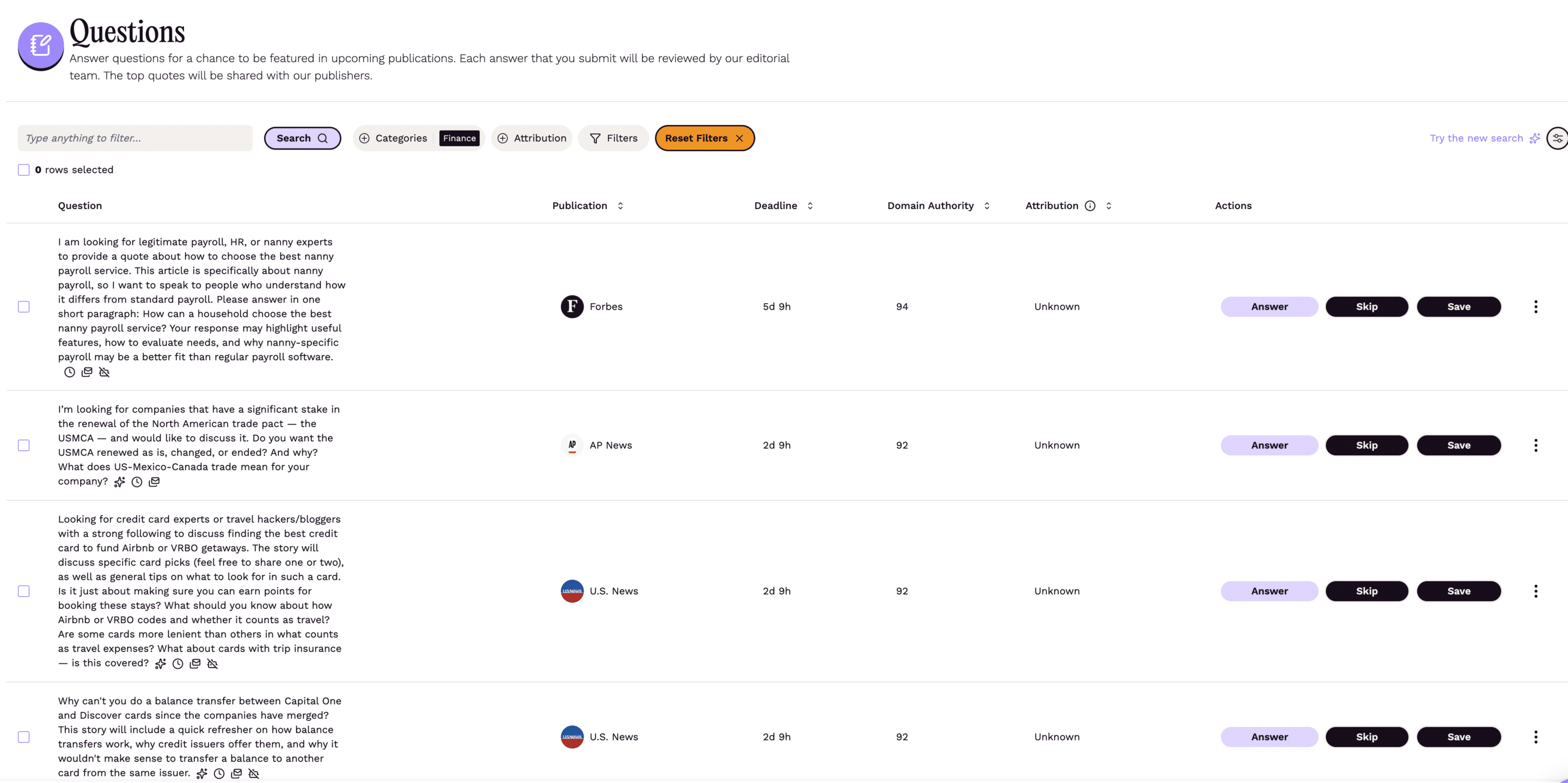
You’ll find opportunities here to provide commentary for articles on Forbes, CNBC, and Bloomberg that are difficult to build links on through outreach and guest posting alone.
These types of fintech links are also published under an editorial decision, rather than through a paid placement, meaning that they carry strong E-E-A-T signals for improved ranking.
If you want to earn backlinks through Connectivley and Qwoted, here’s a step-by-step to get you started:
- Optimise Your Profile: Before you start answering queries, ensure that your Connectively Dashboard profile is optimised to advertise your expertise as a trusted source. Include your exact title, company and even links to past commentary in other high-brow publications so a journalist can verify your identity.
- Find Thought Leadership Opportunities: Start by identifying the journalists and queries covering your financial niche, trending fintech topics and any other discussions that your brand could naturally weigh in on as a thought leader.
- Answer Promptly: When a relevant query lands in your custom feed, try to reply as soon as possible, especially if the journalist is on a tight deadline. Lead with your answer in the first two sentences and include personalised anecdotes that separate your answer from other generic competition.
- Follow Up With Contact Details: Ensure that you finish off your answer with up-to-date contact details. Whether this is your LinkedIn or email address, providing the journalist with direct contact information makes it easier for them to reach out with any follow-up questions.
Digital PR strategies like this one help your brand build a strong relationship network with prominent fintech bloggers, journalists and powerful publications.
If your brand becomes a trusted source through earned media coverage, you increase your chances of being mentioned and linked out to organically in the future.
Strike up Strategic Integration Partnerships
While striking up link swap partnerships can be beneficial for fintech link building, fostering relationships with integration partners is a game-changer for financial service companies.
If your fintech products integrate with other tools (e.g., Shopify’s digital storefront and Stripe’s payment processing API), this is a great opportunity to build dedicated integration pages and collaborate on content that benefits both brands.
There are two key ways to build fintech links in a strategic partnership:
- API and Integration Hubs: If you’re working with an integrated partner, you’ll want to build fnbtech links to your integration pages. Partner brands such as Shopify and Stripe, for example, link back to these types of pages from their own integration marketplaces and documentation hubs. As a result, your financial service scores a high-quality backlink that drives direct referral traffic.
- Co-Authored Guest Posts: Why not go even further and collaborate with a partner on a piece of content? Whether this is a co-authored resource, industry whitepaper, economic report or topical guest post, you can use this opportunity to naturally link to each other’s core service pages before cross-publishing on both domains.
The win here is that both brands get to pool their distribution networks. As well as adding powerful backlinks to each profile, both you and your partner drive traffic from a new pool of qualified leads.
Outsource Your Fintech Links to a White Label Agency
If you want to scale your backlink acquisition effectively, outsourcing your campaign to a white-label link-building agency like Solvid is a no-brainer.
White label link building is the process of outsourcing your link-building efforts to an agency that delivers high-quality backlinks.
Whether you’re a link-building beginner or want to scale up your campaign, partnering with a third-party service could be the key to improving your fintech backlink profile without having to hire extra help.
We all know that the financial services sector is one of the hardest search niches to crack as a budding link builder. However, with access to vetted publisher networks, financial editors and high-tier business blogs, third-party experts could help boost your visibility and score some incredible placements.
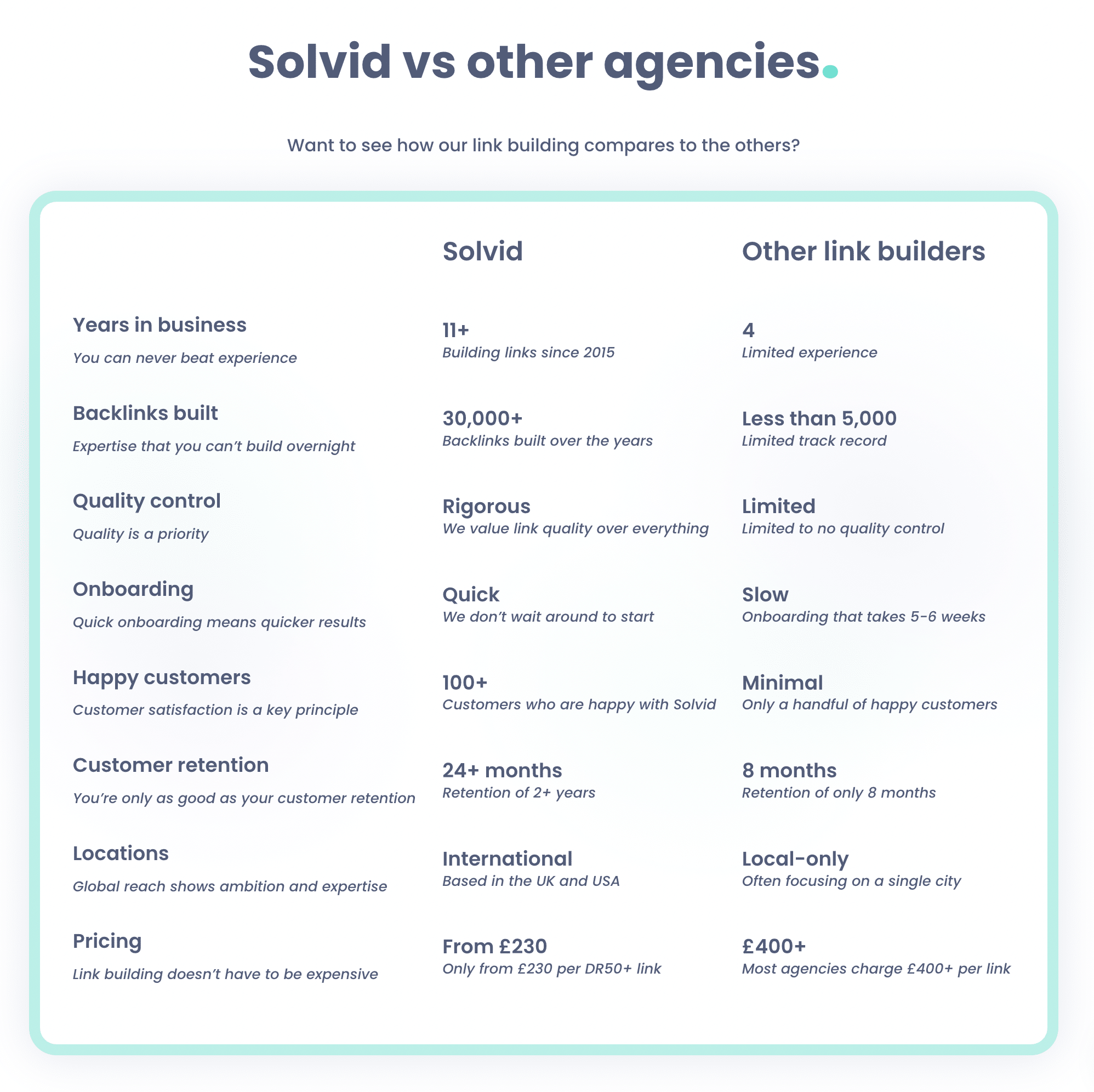
White label link builders like Solvid have strict quality and compliance control to ensure that your placements enhance your SEO profile, not harm it. Financial services demand rigorous compliance, so our team sets strict pre-approval criteria based on your needs.
Whether you choose us or another third-party service, the key is to always do your homework before you outsource. This means reviewing previous case studies, link packages and placements the agency worked on and assessing the SEO growth of their past clients.
The best white-label link builders won’t promise ‘next-day results’ or ‘100+ links a month’. Instead, we strive to build fintech links sustainably on top-tier authoritative publications within your search niche.
How to Build Fintech Links With Solvid
Building fintech links has never been easier with the help of Solvid. With over fifteen years of experience as third-party link builders, we know how to skyrocket the visibility of your financial service.
Here are just some of the websites we get links from:
From guest posting to niche edits to digital PR, our team of dedicated SEO experts create a customised link-building package that fits your search niche.
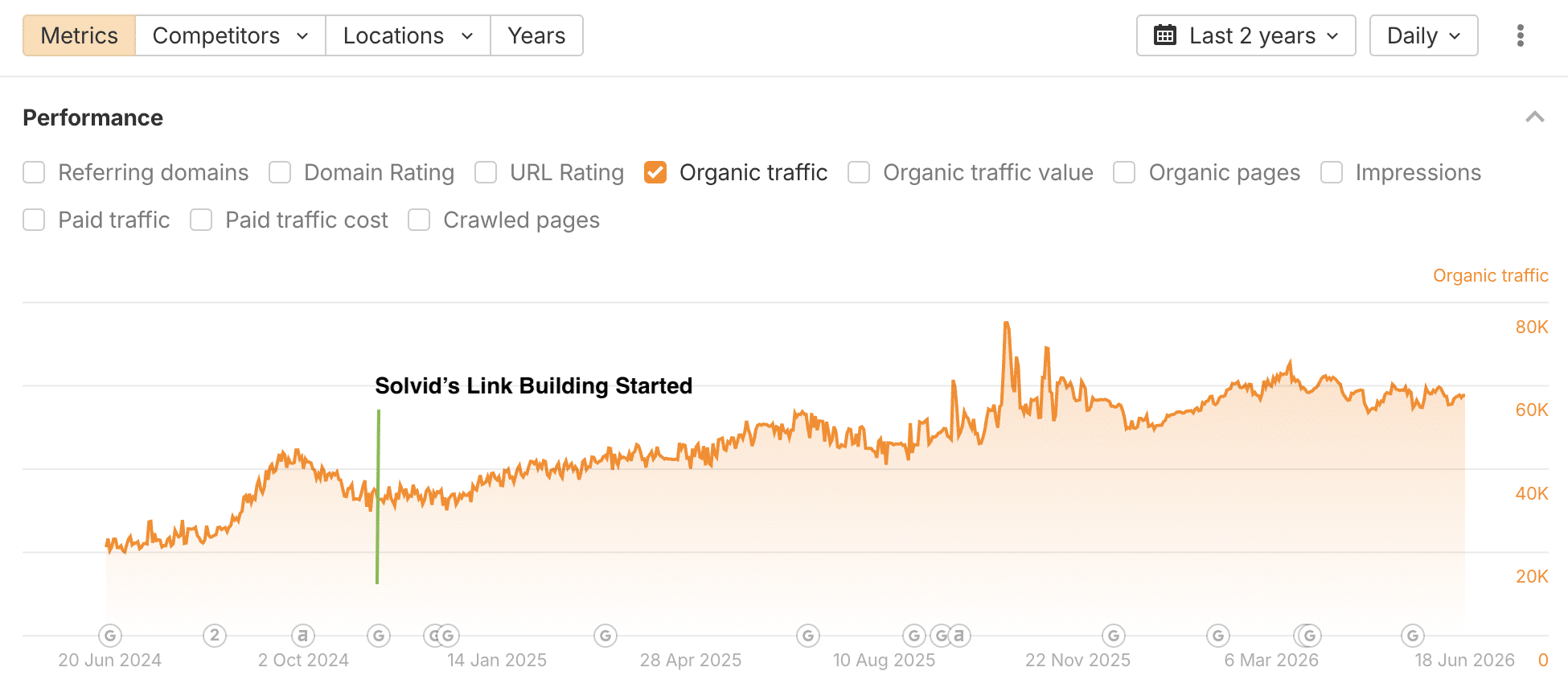
Below is a sample of the traffic increase we achieved for one of our clients.
Balancing YMYL classification and compliance scrutiny can be difficult as a first-time link builder, especially if you’re entering a competitive sector. We aim to streamline the process while staying in line with key rules and regulations enforced by the search engine and your locale.
Still unsure where to start? Speak to one of our link-building experts today and begin your fintech link-building journey.
FAQ
What Is Fintech Link Building and Why Does It Matter?
Fintech link building is the process of acquiring backlinks from domains within the financial services search niche.
Link building in a financial search market is the best way to improve search visibility and drive customer acquisitions.
In a sector where trust and accuracy matter more than ever before, gaining as many ‘trust signals’ as possible from key authoritative domains not only strengthens your credibility with the search engine but also helps guide customers directly to your checkout.
How Can I Build High-Quality Fintech Links in 2026?
Successful fintech link building requires a more strategic approach than traditional link building, especially when you’re trying to target a very competitive sector.
The best way to build high-quality fintech links is to diversify your strategy and your backlink profile.
This means embracing all tactics from creating linkable assets to engaging in digital PR. Some of our favourite link-building strategies include creating shareable financial calculators and tools, engaging with online fintech communities and guest posting on high-traffic websites in your target search industry.
Why Is Fintech Link Building More Expensive Than Other Niches?
Fintech link building operates in a heavily regulated, high-stakes, and hyper-lucrative market.
This means that when a consumer searches for a financial product, their intent most often translates directly into price, which always drives up competitive demand.
If visibility drives engagement and customer acquisition is the key driver of profits, it’s no surprise fintech brands are willing to pay those massive link-building premiums for top-tier placements.
What Types of Websites Are Best for Fintech Link Building?
The best websites for fintech link building are often edu sites, nonprofit pages, and government resources that all meet strict compliance standards and are trusted by search engines in a YMYL space.
If you can secure a fintech link here, your brand is instantly associated with other credible publications that carry significant authority.
Your goal is to score an .edu link from a business school resource page or a .gov link from a state financial literacy portal. For a financial service looking to build SERP authority, these are the most powerful fintech links you can earn.
Should Fintech Companies Outsource Link Building to an Agency?
For those of you looking to scale your backlink acquisition, outsourcing your campaign to a white-label link-building agency could help build up your fintech backlink profile.
White label link building is the process of outsourcing your link-building efforts to an agency that delivers high-quality backlinks.
The financial services sector is one of the hardest search niches to crack as a budding link builder. However, with access to vetted publisher networks, financial editors and high-tier business blogs, third-party experts could help boost your visibility and score some incredible placements.
White-label link builders like Solvid have strict quality and compliance controls to ensure that your placements enhance your SEO profile rather than harm it. Financial services require rigorous compliance, so our team sets strict pre-approval criteria tailored to your needs.
 194 customers signed up in the last 30 days




 hello@solvid.co.uk