Free Keyword Density Checker


See exactly which words and phrases any page repeats, and whether it crosses into over-optimisation. Works on live URLs, including JS-rendered pages. You get one, two and three-word phrase counts with density percentages, plus a clear warning band when a phrase is being leaned on too hard.

What is keyword density.

Keyword density is the share of a page’s words taken up by a particular word or phrase. If a 1,000-word article uses “running shoes” 15 times, that phrase has a density of 1.5%. It is one of the oldest measurements in SEO, dating from an era when search engines really did count word frequency to work out what a page was about. Modern search engines are far cleverer than that, but the measurement still has a genuinely useful job.

That job is diagnosis. Density will not tell you what to add to a page, but it is very good at exposing what has gone wrong. A target phrase sitting at 5 or 6% almost always means the copy reads awkwardly and was written with one eye on the search engine rather than the reader. Google’s spam policies call this keyword stuffing, and pages that do it tend to underperform, get rewritten in the SERP or get filtered entirely.

The over-optimisation risk cuts the other way too. Sometimes an important page never mentions its own target phrase in the title, the H1 or the opening paragraph, and density analysis surfaces that gap in seconds. The healthy range for a primary phrase is roughly 0.5 to 2.5%, occurring naturally in the places that matter. This tool measures exactly that, for every phrase on the page, not just the one you thought to check.

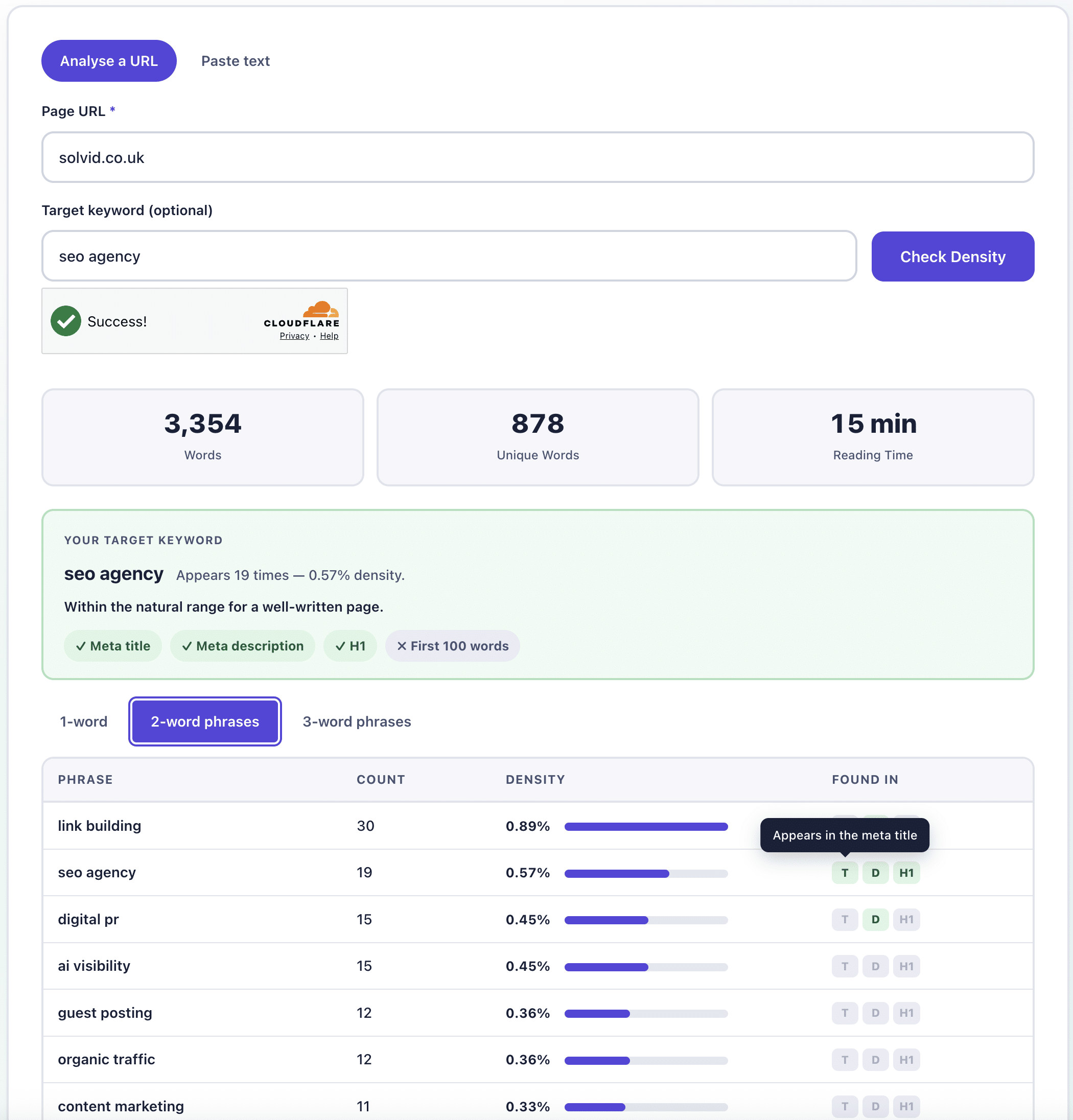
Here’s how the tool looks:
Keyword Density Checker

How to use the keyword density checker.

Enter your URL or paste your content

Paste any live URL, yours or a competitor’s. Optionally add a target keyword and the tool will report on it specifically, including where it appears on the page. Working on an unpublished draft? Switch to paste mode and drop in up to 20,000 characters. The analysis runs identically, with no fetching involved.

Run the analysis

The page is fetched and rendered server-side, including JavaScript content, then the main text is extracted along with the title, meta description and headings.

Read the phrase tables

Three tabs show the top one, two and three-word phrases with counts, density bars and icons marking which phrases appear in the title, description and H1.

Check the target keyword card

If you supplied a keyword, a dedicated card shows its count, density and presence in the first 100 words, with a guidance band from natural through to possible over-optimisation.

Who can use this checker.

Useful whenever the question is “what is this page actually saying, and how often?”

Content writers

Check a draft reads naturally before it ships, without hand-counting phrases

Editors

Catch repetitive phrasing and stuffing in submitted copy in one pass

SEO specialists

Diagnose over-optimised pages during audits and confirm fixes after rewrites

Agencies

Show clients precisely why a page reads like it was written for robots

Competitor researchers

See which phrases a top-ranking page emphasises and where it places them

Website managers

Sense-check older posts that were written back when stuffing was fashionable

eCommerce teams

Audit template-generated category copy that repeats itself without anyone noticing

Freelancers

Add a quick, evidence-backed content check to client deliverables

Why we built this Keyword Density tool.

Solvid has audited and rewritten client content for 11+ years, and on-page reviews are part of every SEO retainer we run. One of the recurring finds is the page that repeats its target phrase relentlessly: in the title, in every H2, twice per paragraph. Usually nobody did it on purpose; it accumulated over years of small edits by different hands. The copy reads badly, and it underperforms.

The opposite case comes up just as often: a service page that somehow never says what it is about in the places that count. Both problems take a human minutes to fix once they are visible, but making them visible used to mean pasting content into clunky tools that choked on JavaScript-rendered pages or mangled the extraction. So we built a checker that fetches pages the way modern sites actually work and puts the numbers in front of you cleanly.

It is free with a generous limit because the analysis costs us almost nothing to run. No AI, no expensive data providers, just careful text processing. Tools like this keep the rest of the web slightly more readable, which suits everyone.

A note on limits: Density is a diagnostic, not a target. Do not edit a page to hit a percentage; edit it so a human reads it happily and the topic is unmistakable. Modern SEO rewards covering a subject well, not repeating a phrase often.

How the tool works.

When you submit a URL, the page is fetched through a server-side rendering pipeline that executes JavaScript before extraction, so single-page applications and JS-heavy templates are analysed on their real content rather than an empty HTML shell. The extractor isolates the main content and captures the title, meta description and headings separately, since phrase placement in those elements is half the story.

The analysis itself is deterministic text maths, with no AI involved. Common English stopwords are filtered out, then the tool computes the top twenty one-word, two-word and three-word phrases, each with its raw count and density as a share of total words. Your target keyword, if provided, gets its own card showing density against a guidance band: roughly 0.5 to 2.5 percent reads as natural, while anything above 4 percent is flagged as possible over-optimisation. Deliberately warn-level language, because density alone never proves a problem.

Because there is no AI processing cost, results are fast and the rate limits are generous. URL results are cached for 24 hours; paste mode runs entirely on the text you provide and stores nothing beyond the session.

Please Note:

1. This tool is provided for free as-is. Density figures are a diagnostic aid; we make no guarantees about rankings or traffic based on any result shown here.

2. Analysis reflects the page as fetched at the time of the check. Pages behind logins, paywalls or aggressive bot protection may not extract fully; use paste mode instead.

3. URL results are cached for up to 24 hours. Text submitted in paste mode is processed for the analysis only and not stored beyond the session.

4. Guidance bands are editorial rules of thumb, not statements about Google penalties. No density figure on its own indicates a penalty.

FAQ.

Quick answers on density, stuffing and how the checker handles tricky pages.
What is a good keyword density percentage?
Somewhere between 0.5 and 2.5 percent tends to read naturally for a target phrase. There is no magic figure Google rewards. Above roughly 4 percent the repetition usually becomes obvious to readers, which is the real problem worth fixing.
What is keyword stuffing exactly?
Repeating a keyword or close variants so often that the text stops sounding human: cramming it into every heading, sentence and alt tag. Google names it explicitly in its spam policies, and pages that do it tend to underperform or get filtered.
Can I paste text instead of a URL?
Yes. Paste mode accepts up to 20,000 characters and skips fetching entirely, which is handy for unpublished drafts, paywalled pages or content still in a Google Doc. The analysis is identical to URL mode.
Is the keyword density checker free?
Yes, and it is one of our cheapest tools to run because the analysis is pure text maths with no AI processing. That lets us offer a generous rate limit of checks per hour without any signup or email gate.
Does keyword density affect Google rankings?
Not as a direct factor. Google understands topics through far more sophisticated signals than word counting. Density matters as a diagnostic: unnaturally high repetition is a symptom of writing for bots, and Google is good at spotting that pattern.
Does the tool work on JavaScript pages?
Yes. Pages are fetched through a rendering pipeline that executes JavaScript before extracting the text, so content on React, Vue and similar frameworks is analysed properly. A plain fetch fallback covers pages where rendering is unnecessary.
Which phrase lengths does the checker count?
Single words, two-word phrases and three-word phrases, shown in three separate tabs. Each tab lists the top twenty phrases with counts, density percentages and icons showing whether the phrase appears in your title, meta description or H1.
Does it work on non-English pages?
It will count and score phrases in any language. The stopword filter that removes common filler words is English-only for now, so results for other languages may include words like articles and prepositions in the top phrases. If a full content review would help, see our website audit service.
UK SEO Agency

UK Address: 6 St. Davids Square, London, E14 3WA, United Kingdom

USA SEO Agency

US Address: 9100 Wilshire Blvd East Tower, Suite 333, Beverly Hills, CA 90212, United States

SEO Accreditation Large

Solvid is an international SEO and link building agency. Solvid is a registered trademark of Solvi & Heirs LTD, registered in England and Wales. Registered Address: 6 St. Davids Square, London, England, E14 3WA

VAT: GB 326425708

Reg: 09697233

020 7072 8788

hello@solvid.co.uk

Clutch
Trustpilot - Solvid
Solvid on LinkedIn
SEMRush partners - Solvid