Bulk Domain Authority and Page Authority Checker

Vet an entire outreach list in one go. Paste up to 5 domains and get DA, page authority, spam score and linking domains side by side.

0 / 5 domains

What is Domain Authority.

Domain Authority is Moz’s 1 to 100 score of how strong a domain’s link profile is, and in outreach it works as the first quality gate. Before anyone pitches a guest post, requests a niche edit or sends a PR story, the prospect list gets filtered by DA. Sites below the threshold are cut, sites with suspicious spam scores are cut, and only then does the human vetting start. The metric is imperfect, but as a fast first pass it saves enormous amounts of wasted outreach.

The trouble is that prospect lists never arrive one domain at a time. They arrive as spreadsheets: fifty domains from a scrape, twenty from a competitor’s backlink profile, a dozen from a marketplace. Checking those through a single-domain tool means copy, paste, wait, record, repeat. It is slow, error-prone and exactly the kind of work that makes outreach teams cut corners on vetting, which is how bad links get bought.

A bulk checker fixes the workflow rather than the metric. Paste the list, get every score in one table, sort by DA or spam score, export the survivors. The judgement calls still belong to a human; the tool just makes sure the data arrives fast enough that the judgement actually happens.

What is Page Authority.

Page Authority is the same idea applied one level down. Where DA scores an entire domain, PA scores a single page on its own merits: the links pointing at that specific URL, the internal authority flowing to it and how likely it is to rank by itself. The two numbers often disagree, and the disagreement is the useful part. A DA 70 site can host a brand-new page with almost no authority, and a DA 35 blog can have one article that half the industry links to.

That distinction matters most in link building. If you are negotiating a niche edit, the page your link will actually sit on matters more than the domain’s headline number. A placement on a strong page of a modest site frequently outperforms a placement buried on a weak page of a famous one. Checking PA alongside DA stops you paying domain prices for page-level value.

This tool returns both for every line on your list, so the comparison happens automatically. Domains where DA and PA sit close together are usually consistent sites. Big gaps in either direction are worth a manual look before you commit a pitch or a budget.

How to use the bulk DA and PA checker.

Paste your domain/URLs list

Add up to 5 domains or URLs, one per line. The tool cleans up full URLs, strips www and flags duplicates or junk lines before anything is submitted.

Run the batch check

One click sends the whole list in a single batched query to Moz’s index. Cached domains return instantly; the rest usually arrive within a few seconds.

Sort and scan the table

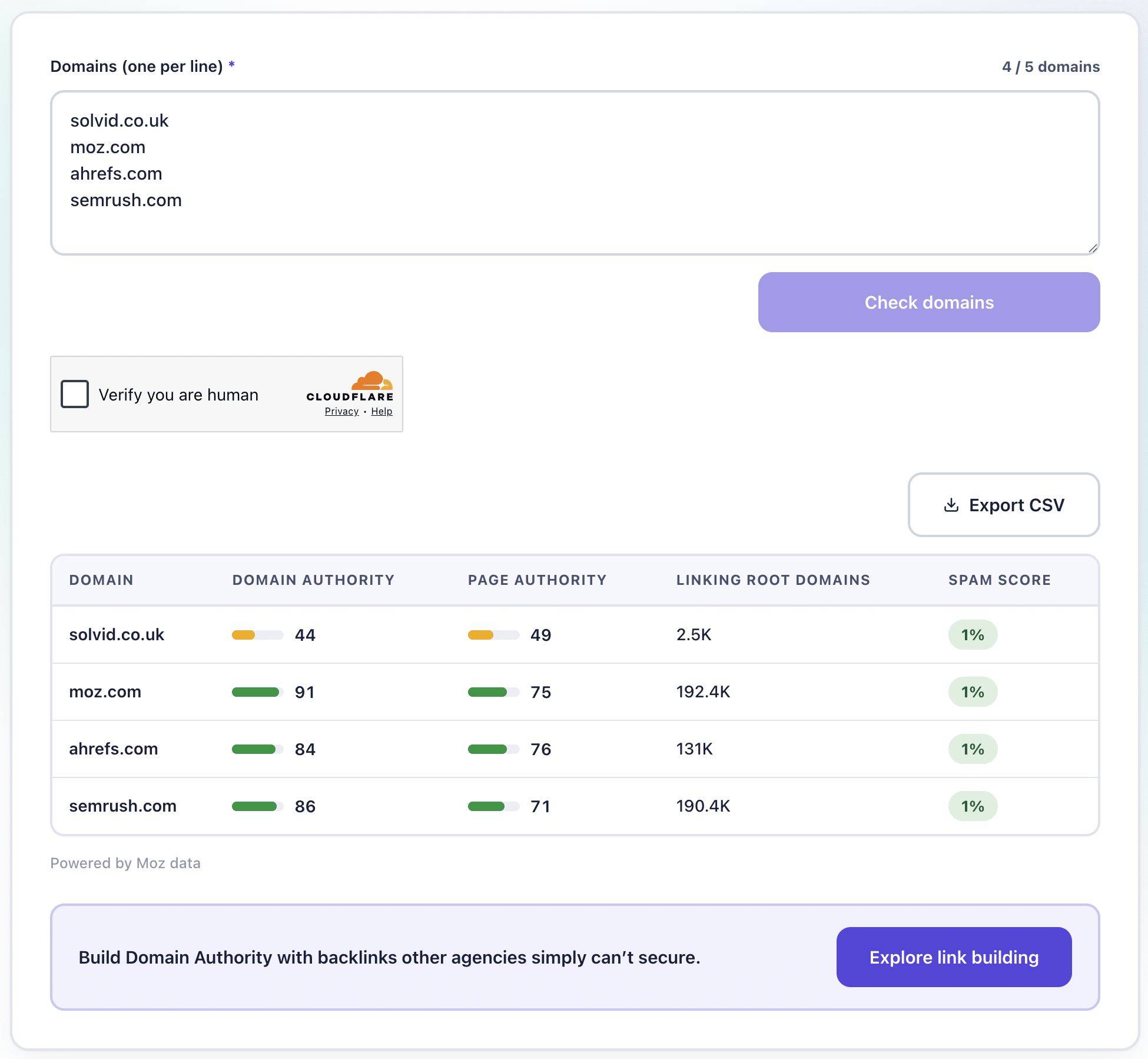
Each row shows DA as a colour-banded pill, linking root domains and spam score. Click any column header to sort, and use the summary strip for the average, highest and lowest DA.

Export

Download the table as a CSV for your outreach sheet, retry any row that failed, and move the domains that pass your threshold into the pitching queue.

Why use our Bulk DA and PA Checker.

Most free DA checkers make you work one domain at a time, cap you behind a signup wall, or return DA alone with no context. This one is built the way an outreach team actually vets: the whole list in one submission, DA and PA side by side, spam score and linking root domains in the same row, and a CSV at the end. Nothing to install, nothing to register for, no daily email required.

It is also honest about what the numbers are. DA and PA are Moz’s proprietary predictions, not Google ranking factors, and we display them unmodified rather than blending them into some invented score of our own. You see exactly what Moz reports, which means your thresholds stay comparable with every other Moz-based tool your team or your clients use.

And because the checks run as one batched request against a cached index, it is quick. A full list typically comes back in seconds, re-running a list you checked earlier is instant, and a single failed domain gets its own retry button instead of forcing you to resubmit everything. Small details, but they are the difference between vetting that happens and vetting that gets skipped.

Who this DA tool is for.

Built for anyone who vets websites in lists rather than one at a time.

Link builders

Filter prospect lists by DA and spam score before a single pitch goes out

Outreach managers

Standardise vetting across the team with one shared threshold and one export format

Agencies

Vet placement lists from vendors and marketplaces before spending client budget

Digital PR teams

Qualify a media list in seconds and prioritise the publications that carry authority

SEOs

Benchmark your domain against a set of competitors in one submission

Affiliate managers

Check partner and publisher sites in bulk before approving them into a programme

Domain buyers

Compare a shortlist of expired or aged domains side by side before bidding

Freelancers

Turn a client’s messy prospect spreadsheet into a vetted list without a paid seat

Why we built it.

Solvid has run link building campaigns since 2015: 11+ years, 30,000+ backlinks built, and a DA or DR check on every single prospect before it earns a place on an outreach list. That last part is non-negotiable for us. A link from a weak or spammy domain is not a bargain; it is a liability that someone later has to disavow.

At our volume, single-domain checkers stopped making sense years ago. Prospect lists arrive in batches, so the vetting has to happen in batches. We built internal tooling that takes a pasted list and returns DA, spam score and linking domains in one table, and it quietly became one of the most-used utilities in the company. Turning it into a public tool was the obvious next step.

This page is that tool. Same data source, same table, same CSV export our own team uses when a new prospect list lands. Free, because the SEO community has given us plenty over the years and fast vetting makes the whole ecosystem a little less spammy.

A note on limits: Bulk metrics speed up vetting; they do not finish it. We never buy or pitch a placement on numbers alone. Once a domain passes the DA and spam filter, look at its content, its traffic and who actually reads it before you commit.

How the DA PA Checker works.

The bulk checker reuses the same data layer as our single Domain Authority Checker, talking to the Moz Links API. Moz owns and calculates Domain Authority; we request DA, PA, linking root domains and spam score for each domain on your list and display the figures unmodified. Your 5 domains go to Moz as one batched request rather than five separate calls, which is why a full list comes back in seconds.

Before anything is sent, the tool normalises your input: full URLs are reduced to root domains, duplicates are removed, and unusable lines are flagged rather than silently dropped. Results are cached per domain for 24 hours, so re-running a list is instant, and a domain that fails mid-batch gets its own retry button instead of sinking the whole submission.

As with any DA tool, remember what the number is: a Moz prediction of ranking ability built from link data, not a score Google uses. It is excellent for comparing domains against each other, which is precisely what a bulk table is for. It is not a promise about how any of those sites will perform.

Please Note:

1. This tool is provided for free as-is. Domain Authority and spam score are metrics owned and calculated by Moz; we display them under licence and cannot alter individual scores.

2. DA is not a Google ranking factor. No guarantees are made about rankings, traffic or outcomes based on any figure shown here.

3. Results are cached for up to 24 hours per domain, so very recent link changes may not appear immediately.

4. Fair-use submission limits apply to keep the tool fast for everyone. If you routinely vet larger lists, get in touch and we can help.

FAQ.

Quick answers on bulk checks, the data behind them and how to read the table.
What is Domain Authority (DA)?
Domain Authority is Moz’s 1 to 100 score predicting how well a domain is likely to rank, based on the strength of its link profile. Higher is stronger. It is a comparative metric, so it works best for weighing domains against each other rather than reading any single score in isolation.
What is the difference between DA and PA?
Domain Authority scores the whole domain; Page Authority scores one specific page. A high-DA site can host weak pages, and a modest site can have one very strong page. In outreach, DA tells you the site is worth talking to and PA tells you which page on it carries the most weight.
What are Linking Root Domains?
The number of unique websites that link to a domain at least once. Ten links from ten different sites count as ten linking root domains; ten links from the same site count as one. It is one of the strongest signals of genuine authority, which is why we show it next to DA.
Is the bulk DA and PA checker free?
Yes, completely free with no signup. Fair-use limits apply to keep it fast for everyone. If you routinely vet much larger lists, get in touch and we can help with that workflow.
Where does the bulk data come from?
Directly from the Moz Links API. Moz owns and calculates DA, PA and spam score; we request the figures for each domain on your list and display them unmodified. We do not adjust or reweight any score.
What is Page Authority (PA)?
Page Authority is Moz’s 1 to 100 score for a single page rather than a whole domain. It predicts how well that specific URL is likely to rank based on its own link profile. Useful when you are vetting a specific page for a link placement rather than a whole site.
What is Spam Score?
Moz’s estimate of how similar a site looks to sites that have been penalised or banned by Google, shown as a percentage. It is a warning light, not a verdict. A high score means look closer before you link, not automatically avoid.
How many domains can I check at once?
Up to 5 domains or URLs per submission, one per line. The tool cleans full URLs to root domains, strips www and flags duplicates before submitting. Need to vet bigger lists regularly? Contact us and we will sort something out.
Can I export the results to CSV?
Yes. One click downloads the full table as a CSV, ready to paste into your outreach sheet. Every column you see on screen is included: DA, PA, linking root domains and spam score.
What counts as a safe Spam Score?
Moz brackets 1 to 30 percent as low, 31 to 60 as medium and 61-plus as high. We treat anything over 30 as a prompt for manual review rather than an automatic rejection. Some perfectly good niche sites carry mid-range scores, and some bad ones score low.
UK SEO Agency

UK Address: 6 St. Davids Square, London, E14 3WA, United Kingdom

USA SEO Agency

US Address: 9100 Wilshire Blvd East Tower, Suite 333, Beverly Hills, CA 90212, United States

SEO Accreditation Large

Solvid is an international SEO and link building agency. Solvid is a registered trademark of Solvi & Heirs LTD, registered in England and Wales. Registered Address: 6 St. Davids Square, London, England, E14 3WA

VAT: GB 326425708

Reg: 09697233

020 7072 8788

hello@solvid.co.uk

Clutch
Trustpilot - Solvid
Solvid on LinkedIn
SEMRush partners - Solvid