XML Sitemap Generator

Enter your domain and get a valid, ready-to-submit XML sitemap. We crawl the site, you download the file and upload it to Search Console. The crawler respects robots.txt, works politely at about one page per second, and handles up to 100 URLs per job.

What is an XML sitemap.

An XML sitemap is a structured file that lists the pages on your website you want search engines to know about. Each entry holds the page’s URL and, optionally, when it last changed, how often it tends to change and how important it is relative to your other pages. Search engines read the file as a crawling roadmap. It does not replace normal crawling through links; it supplements it, making sure nothing worth indexing gets missed.

You need one most when discovery is hard. New sites with few backlinks, large sites with thousands of pages, sites with weak internal linking, and sites whose content changes frequently all benefit measurably. A sitemap also gives you a diagnostic channel: submit it in Google Search Console and Google reports how many of the listed URLs are indexed and flags problems with the rest. That indexed-versus-submitted gap is one of the most useful numbers in technical SEO.

For a small, well-linked brochure site, a sitemap is less critical, but it costs nothing and never hurts. Every professional SEO setup includes one as standard, referenced from robots.txt and submitted to Search Console. If your CMS does not produce one, or produces one full of junk URLs, generating a clean file is a ten-minute fix with long-term value.

How an XML generator looks:
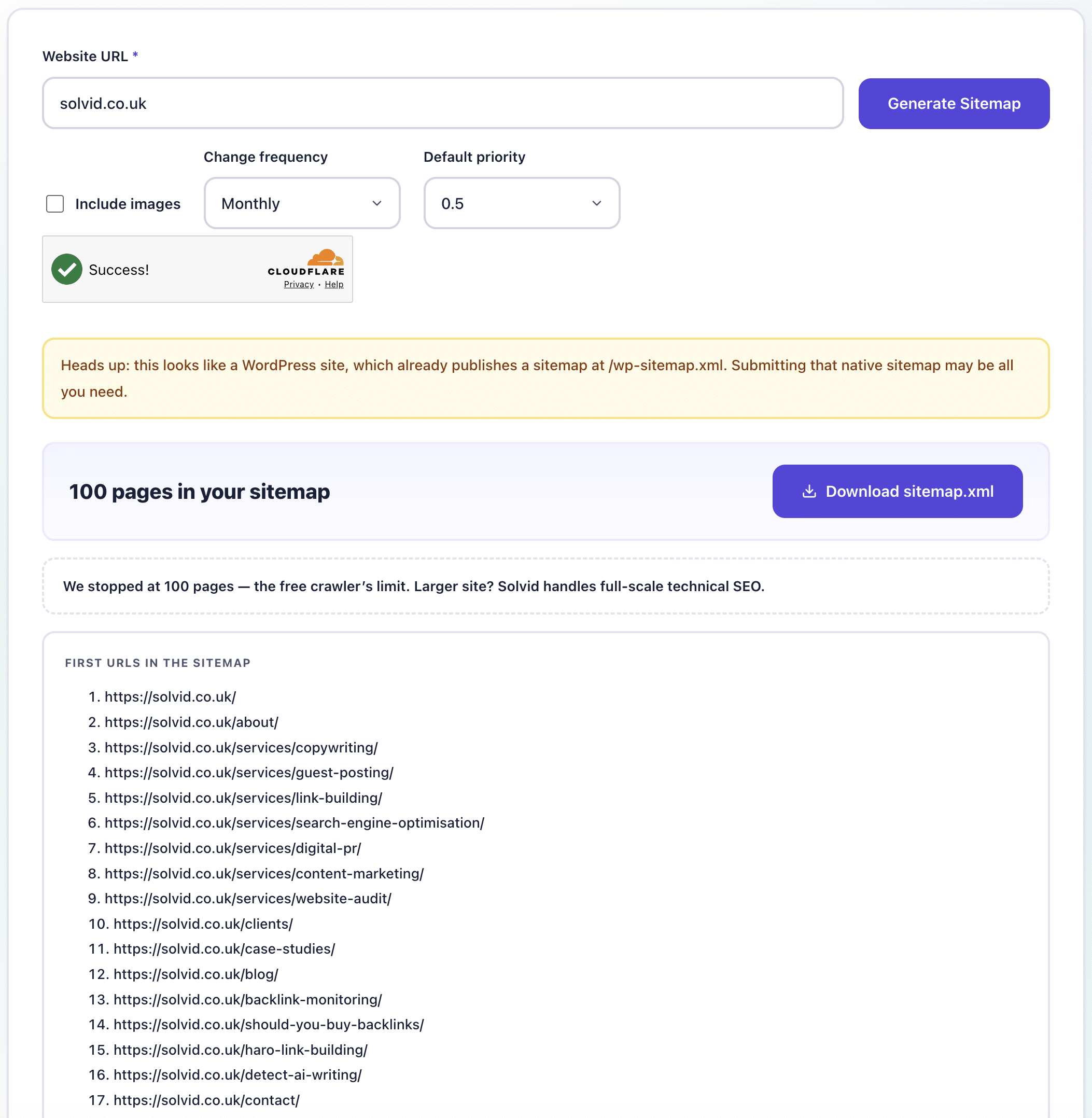
XML Sitemap Generator

How to use the XML sitemap generator.

Enter your website URL

Type your domain and choose your options: include image entries, set a default change frequency and a default priority for the listed URLs.

Start the crawl

The crawler begins at your homepage and follows internal links, reading robots.txt first and skipping anything disallowed, duplicated or broken along the way.

Watch the progress

Crawling runs as a background job, so you see a live counter of pages found and crawled. Large sites take a few minutes; you can cancel at any point.

Download your sitemap.xml

When the crawl completes you get the page count, a preview of the first URLs and a download button for the finished, validated XML file.

Who this generator is for.

For anyone whose site needs a clean sitemap and whose CMS will not provide one.

Site owners

Get a proper sitemap live without touching code or paying for a plugin

Developers

Generate a sitemap for static builds, custom stacks and launches where no CMS emits one

Technical SEOs

Produce a clean crawl-based sitemap to compare against what the CMS claims exists

Agencies

Fix missing or broken sitemaps on inherited client sites during onboarding

Small online stores

Help search engines find every product and category page on platforms with poor defaults

Bloggers

Make sure archives and older posts stay discoverable as the site grows

Migration specialists

Snapshot the URL set before and after a redesign or domain move

Freelancers

Tick the sitemap box on client projects quickly, with a file you can trust validates

Why we built this.

Sitemap problems appear in a surprising share of the website audits Solvid has run over 11+ years. Sites with no sitemap at all. Sitemaps referencing pages deleted years ago. Sitemaps full of redirect chains, staging URLs and parameter junk. None of these issues is dramatic on its own, but each one wastes crawl attention that a growing site needs, and together they blunt everything else you do in SEO.

The fix is usually simple: crawl the site as it actually exists today and rebuild the file from reality. That is precisely what this tool does. We built the crawler for our own audit work, where we need a trustworthy picture of a site’s real, reachable URL set, and packaged the sitemap output as a free public tool because the need comes up constantly outside audits too.

We were also deliberate about crawler manners. Our team spends its days asking webmasters for links; the last thing we want is a tool that hammers anyone’s server. So the crawler is polite by design, honours robots.txt without exception and identifies itself clearly in your logs.

A note on limits: A sitemap helps search engines find your pages; it does not make them rank. Indexing still depends on content quality, internal linking and site health. If Search Console shows submitted pages that will not index, that is an audit conversation, not a sitemap one.

How the generator works.

The generator is a polite server-side crawler with strict rules. It fetches your robots.txt first and honours every disallow directive, then crawls same-host HTML pages only, at roughly one request per second, identifying itself with a named user agent so you can see it in your server logs. It skips nofollow links, canonicalises query-string duplicates, ignores non-200 responses and stops at a hard cap of 500 URLs per job.

Because a real crawl takes time, the work runs as a background job: you start it, a status endpoint reports progress every couple of seconds, and you can cancel whenever you like. When the crawl finishes, the tool builds a sitemaps.org-valid urlset, with lastmod dates taken from each page’s Last-Modified header where the server provides one, plus your chosen changefreq and priority defaults and optional image entries. The download link stays live for 24 hours, after which the file is purged.

One honest note: if your site runs WordPress or a similar CMS, you may already have a sitemap at /wp-sitemap.xml or via your SEO plugin. The tool checks and tells you, because a maintained CMS sitemap that updates itself automatically is usually the better long-term option. This generator is for everyone whose platform does not offer that.

Please Note:

1. This tool is provided for free as-is. A sitemap assists discovery; we make no guarantees about indexing, rankings or traffic resulting from its use.

2. Only run the generator on sites you own or are authorised to work on. The crawler honours robots.txt and rate limits itself, but responsibility for where you point it rests with you.

3. Crawls are capped at 100 URLs, depth-limited and throttled to roughly one request per second. Very large or slow sites may return a partial sitemap, which the results clearly flag.

4. Generated files and job data are deleted automatically after 24 hours. Download your sitemap promptly after the crawl completes.

FAQ.

Quick answers on sitemaps, the crawler’s behaviour and what to do with the file.
What is an XML sitemap for?
It is a machine-readable list of your site’s pages that search engines use as a crawling roadmap. It helps them find every URL you care about, including pages with few internal links, and signals when each page last changed.
How many URLs can the generator crawl?
Up to 100 URLs per job. The crawler stops politely at the cap and tells you it did, so you know the sitemap is partial. Sites larger than that usually generate sitemaps from their own CMS, or we can help directly.
Where do I upload the sitemap file?
To the root of your website, so it is reachable at yourdomain.com/sitemap.xml. Then add a Sitemap line pointing to it in your robots.txt file. Your host’s file manager, FTP or your CMS’s file upload can all do the job.
Does WordPress already generate a sitemap?
Usually yes. WordPress core emits one at /wp-sitemap.xml, and SEO plugins like Yoast provide their own. The tool checks for an existing sitemap and tells you if one is already live, so you do not end up running two.
Do I really need an XML sitemap?
Small, well-linked sites often get crawled fine without one, but a sitemap never hurts and costs nothing. It matters most for new sites, large sites, sites with weak internal linking and pages that change frequently.
Does the crawler respect robots.txt rules?
Yes, strictly. It reads your robots.txt before crawling, skips disallowed paths, identifies itself with a named user agent and fetches roughly one page per second. If robots.txt blocks everything, the tool explains that rather than crawling anyway.
How do I submit it to Google?
Open Google Search Console, choose your property, go to the Sitemaps report and enter the sitemap URL. Google fetches it, reports any errors and re-checks it periodically. Bing Webmaster Tools works the same way.
Is the XML sitemap generator free?
Yes. No signup and no charge for crawls up to 100 URLs. Because crawling uses real server resources on both ends, jobs are limited per day per user, which covers normal use comfortably. Larger site? Our website audit service includes a full technical crawl.
UK SEO Agency

UK Address: 6 St. Davids Square, London, E14 3WA, United Kingdom

USA SEO Agency

US Address: 9100 Wilshire Blvd East Tower, Suite 333, Beverly Hills, CA 90212, United States

SEO Accreditation Large

Solvid is an international SEO and link building agency. Solvid is a registered trademark of Solvi & Heirs LTD, registered in England and Wales. Registered Address: 6 St. Davids Square, London, England, E14 3WA

VAT: GB 326425708

Reg: 09697233

020 7072 8788

hello@solvid.co.uk

Clutch
Trustpilot - Solvid
Solvid on LinkedIn
SEMRush partners - Solvid