GEO Content Scorer

Paste a URL or draft and get a 0 to 100 score for how likely AI engines are to cite it. With line-by-line fixes to raise it. The scorer shows you the exact sentences an AI would quote from your page, and the five changes that would make it quote more.

What is AI citability.

AI citability is how usable your content is as a source when an AI engine answers a question. When ChatGPT, Perplexity or a Google AI Overview builds an answer, it pulls from pages that make its job easy: clear claims, hard numbers, named entities, direct answers near the top, structure it can parse. Content that has those qualities gets quoted and linked. Content that doesn’t gets skipped, no matter how well it reads to a human.

This is the working problem of generative engine optimisation, or GEO. The research on generative engines keeps landing on the same findings: adding statistics, quotations and citations to a page measurably raises how often engines use it. So does answer-first structure, short paragraphs and explicit naming of people, products and organisations rather than a wall of “we” and “our solution”. None of this is guesswork any more. It is checkable, and much of it is checkable mechanically.

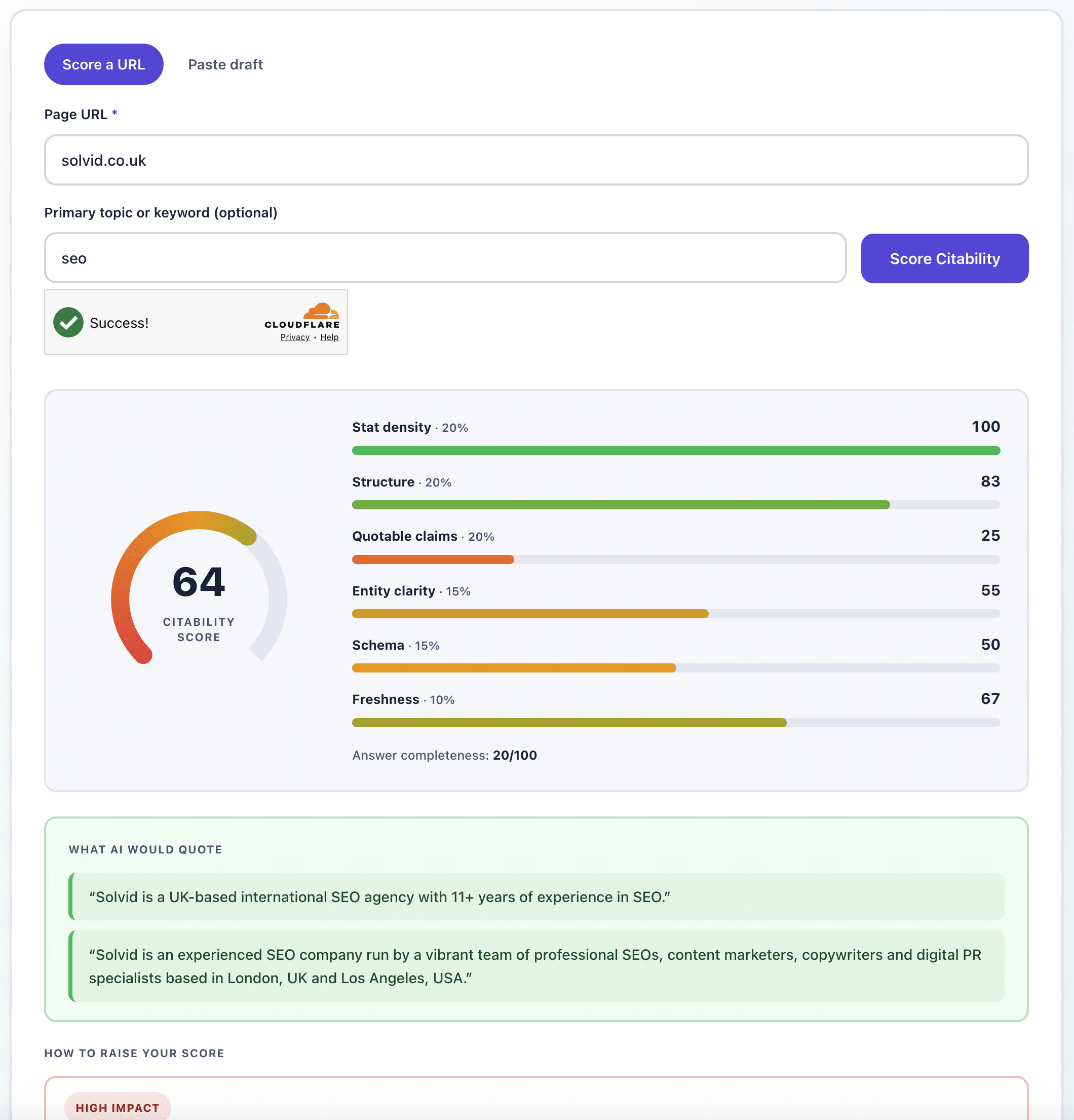
That is what this scorer does. It runs your page or draft through a set of deterministic checks (statistics density, structure, schema markup, freshness) and an AI-assessed rubric (quotable claims, entity clarity, answer completeness), then blends them into a single 0 to 100 citability score. Alongside the score, you get proof and a plan: the two sentences an AI would most plausibly cite from your text, and the top five fixes ranked by impact, each with an example rewrite.

Here’s how the tool looks:
GEO Content Checker

How to use our GEO Content Checker.

Choose URL or draft mode

Test a live page by pasting its URL, or paste raw text for anything unpublished. Drafts of up to 25,000 characters are fine. URL mode adds schema and freshness checks that raw text can’t provide.

Add your primary topic (optional)

If you tell the scorer what the content is meant to answer, it can judge focus and completeness against that topic rather than guessing from the text.

Run the score

The tool computes four deterministic sub-scores and one AI analysis pass, then combines them with published weights into your citability score. Results arrive in seconds, with all six factor bars visible.

Read what an AI would quote and optimise

The “what AI would quote” box shows the two strongest sentences in your text. If they’re weak, that’s your standard to fix. Below it, five fix cards are ordered by impact, each with a before-and-after example rewrite.

Who this scorer is for.

Anyone who writes or commissions content and wants AI engines to cite it.

Content writers

Check drafts before they ship, not after they fail to get cited

Editors

Add a citability gate to your publishing checklist with an objective number

SEOs

Prioritise which existing pages to retrofit for AI search first

Agencies

Score client content at intake and show measurable improvement after your work

B2B marketers

Make product and comparison pages quotable, where buyers now ask their questions

Publishers

Protect reference traffic by making cornerstone articles the source AI engines pick

Founders

Audit the pages that explain what you do, since those are the ones AI paraphrases

AI specialists

AI marketers and specialists optimising content for LLMs and AI search

Why we built this GEO Checker.

Solvid has been an SEO and link building agency since 2015. For most of those 11+ years, content optimisation meant one thing: make the page worthy of a Google ranking. Then our clients’ buyers started getting answers from ChatGPT and AI Overviews instead of clicking results, and a new question landed on our desks: is our content the kind AI engines actually quote?

When we launched our GEO and AI SEO service, we needed a repeatable way to answer that question for every client page. Generic content scores didn’t measure the right things, so we codified what the generative engine research and our own client work kept showing: stats, structure, quotable claims, clear entities, schema and freshness. This tool is that internal rubric, made public and free. It scores your content the way we score our clients’ content on day one of an engagement.

A note on scope: This scorer measures your content, not your authority. A perfectly citable page on an unknown domain still needs brand signals and links before engines trust it. Fix the content here, then work on the authority.

How it works under the hood.

The scorer is deliberately hybrid. Four factors are computed mechanically, so they’re consistent and repeatable: statistics density counts numbers, percentages, years and data points per 500 words; structure checks for a direct answer within the first 300 characters, sensible heading frequency, lists or tables and a healthy short-paragraph ratio; schema checks for JSON-LD and high-value types like FAQPage, HowTo and Article; freshness looks for visible dates, a dateModified in the markup and current-year references. Run the same text twice and these four scores will not change.

The remaining factors need judgement, so they go through one structured AI analysis pass with a fixed rubric: quotable claims (self-contained statements an engine could lift verbatim), entity clarity (are people, brands and products named explicitly, and is the author identifiable) and answer completeness. The same pass extracts your two most quotable sentences and drafts the top five fixes with example rewrites.

The composite weights are published: statistics 20%, structure 20%, quotable claims 20%, entity clarity 15%, schema 15%, freshness 10%. In paste mode, where schema and freshness can’t be assessed, their weight is redistributed proportionally across the rest, so a draft is never punished for not being live yet.

Please Note:

1. This tool is provided for free, as-is. The citability score is a diagnostic benchmark, not a guarantee of AI citations, rankings, traffic or any other outcome.

2. AI engines change their behaviour frequently, so scoring criteria reflect current best evidence and will be updated over time.

3. Fair-use rate limits apply so the tool stays free for everyone. Please only score content you own or have permission to analyse.

4. Pasted drafts are processed to produce your score and are not used to train any model. We do not sell your data.

FAQ.

Common questions about the GEO Content Scorer and how to read your score.
What is GEO?
GEO stands for generative engine optimisation: shaping your content so AI engines like ChatGPT, Gemini and Google AI Overviews quote and cite it in their answers. It sits alongside SEO, which optimises for traditional rankings rather than AI citations.
How is GEO different from normal SEO?
SEO earns you a ranking; GEO earns you a citation inside an AI answer. The overlap is real but incomplete. AI engines favour self-contained facts, named sources, clear entities and answer-first structure, things classic SEO checklists rarely measure.
What are quotable claims exactly?
Self-contained, attributable statements an AI could lift word for word, like a statistic with a source or a clear definition. The report highlights the two sentences from your text an AI would most plausibly cite, so you can see the standard to aim for.
Can I re-score after editing my draft?
Yes, that is the intended workflow. Apply a fix, hit re-score and watch the number move. Fair-use limits apply so the tool stays free, but an edit and re-check loop within a writing session works fine.
What does the citability score measure?
How likely an AI engine is to lift and cite your content when answering a related question. It blends six factors: statistics density, structure, quotable claims, entity clarity, schema markup and freshness, each weighted and rolled into one 0 to 100 score.
Should I test a URL or paste a draft?
Both work. URL mode fetches the live page and can also check schema markup and freshness signals. Paste mode is ideal for unpublished drafts, and the weights adjust automatically since schema and dates cannot be checked on raw text.
How reliable is the scoring?
Four of the six factors are deterministic checks, so the same text always gets the same result. The AI-assessed factors use a fixed rubric. Treat the score as a strong diagnostic rather than a physics measurement, and watch it move as you apply fixes.
Does a high score guarantee AI citations?

No. Citations also depend on your site’s authority, how often your brand appears across the web and what competing sources exist. The score tells you whether your content is fit to be cited. Authority is a separate job, and one our GEO and AI SEO service exists to do.
UK SEO Agency

UK Address: 6 St. Davids Square, London, E14 3WA, United Kingdom

USA SEO Agency

US Address: 9100 Wilshire Blvd East Tower, Suite 333, Beverly Hills, CA 90212, United States

SEO Accreditation Large

Solvid is an international SEO and link building agency. Solvid is a registered trademark of Solvi & Heirs LTD, registered in England and Wales. Registered Address: 6 St. Davids Square, London, England, E14 3WA

VAT: GB 326425708

Reg: 09697233

020 7072 8788

hello@solvid.co.uk

Clutch
Trustpilot - Solvid
Solvid on LinkedIn
SEMRush partners - Solvid