Free Keyword Research Tool

Start with one seed keyword and get real search volumes, difficulty scores and up to 50 related ideas worth targeting. It is the research step of SEO, without the subscription. No signup, no card, no sampled data dressed up as the real thing.

What is keyword research.

Keyword research is the process of finding out what your potential customers actually type into Google, how many of them do it each month, and how hard it would be for your site to show up when they do. It turns content planning from guesswork into a decision you can defend: this term gets searched, the competition is beatable, and the intent matches what we offer.

Skipping it is the most common SEO mistake we see. Teams spend months writing about topics nobody searches for, or pour effort into head terms dominated by sites with ten times their authority. Both failures were avoidable with twenty minutes of research up front. The data has always existed; it has just been locked behind subscriptions that cost more per month than many small businesses spend on marketing.

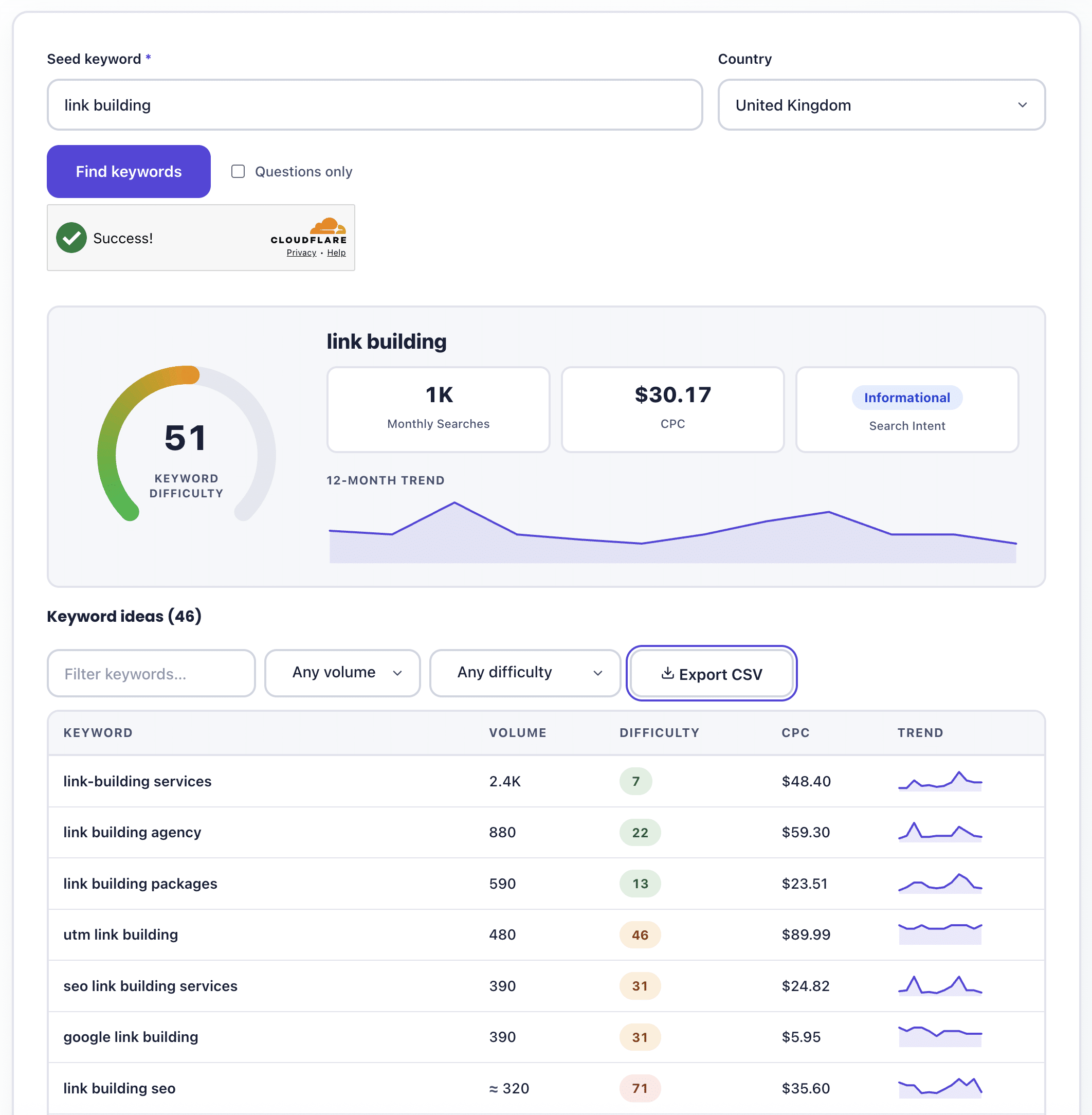
This tool covers the core of that research loop. Give it one seed keyword and it returns the seed’s search volume, difficulty score, cost per click, search intent and a 12 month trend, plus up to 50 related keyword ideas with the same data attached. Tick the Questions only filter and it returns the question phrases people ask around your topic, which are ideal starting points for blog and FAQ content.

Here’s what it looks like:
Keyword Research Tool

How to use the keyword research tool.

Enter a seed keyword

Type one term that describes your topic, such as “accounting software” or “trail running shoes”. Broad seeds return wider idea sets; specific seeds return tighter ones. Keep it under 80 characters.

Pick your market

Choose the country you want data for. The default is the United Kingdom. Volumes and difficulty are specific to each market, so a keyword that looks easy in one country can be brutal in another.

Review the seed overview and AI suggestions

The hero card shows the seed’s monthly volume, a 0 to 100 difficulty gauge, CPC, an intent badge and a 12-month trend sparkline. This tells you whether the seed itself is worth chasing. Our AI engine will also provide keyword suggestions along with volumes and difficulty.

Shortlist and export

Export the table to CSV and build your shortlist. Prioritise keywords where volume is meaningful, difficulty is realistic for your site and the intent matches a page you can actually build.

Who this keyword research tool is for.

Keyword research is an essential practice in organic and paid marketing.

SEOs

Quick research checks without burning a seat on another subscription platform

Content teams

Writers and editors validating topics before a brief gets written

Founders

Early-stage teams doing their own SEO before hiring a specialist or agency

Agencies

Fast keyword sense-checks during pitches, audits and client calls

Publishers and editors

Finding question keywords and long-tail angles worth an article

eCommerce teams

Mapping category and product page targets across every market they sell in

PPC managers

CPC data alongside volume shows which terms are cheaper to win organically

Digital marketers

Full research capability for client work without full-suite pricing

Why we built this tool.

Keyword research is step one of every SEO retainer Solvid has run in 11+ years. Before a single page is written or a single link is built, we work out which terms are worth the effort. It is the highest-value hour in the entire engagement, because everything downstream depends on it.

Yet the free tools available for that step are mostly poor. Some show keyword ideas with no volumes at all. Others show volumes but gate difficulty behind a trial. Most cap you at two or three searches before demanding a card. We wanted something we could point clients and readers to without caveats: real data, sensible limits, nothing held hostage.

So we built this. It uses the same class of data our own team works from, and it covers the part of research that a tool genuinely can do well: surfacing the numbers. What you do with those numbers is where strategy starts.

A note on limits: A research tool gives you candidates, not a strategy. Deciding which keywords map to which pages, how intent shapes the content, and which battles your site can win this year still takes judgement. That is the part we do for clients, and no tool replaces it.

How this keyword research tool works under the hood.

When you run a search, our server queries leading SEO data providers for two things: an overview of your seed keyword and a set of related suggestions. The overview carries volume, CPC, competition, difficulty, intent and 12 months of trend data. The suggestions call returns up to 50 related terms with the same metrics attached. Results are cached for a few days, because keyword data moves slowly and repeat lookups should be instant.

Two honesty notes. First, search volumes are modelled estimates built from clickstream and advertising data, not a live feed from Google. Second, difficulty scores are each provider’s own calculation, based mainly on the authority of pages currently ranking. Different tools will show you different numbers for the same keyword, and that is normal. Use the figures to compare keywords against each other rather than as absolute truths.

Nothing you search for is tied to you or stored beyond routine caching. If you want the research turned into a full content and ranking plan, that is what our SEO service does every day.

Please Note:

1. This tool is provided free, as-is. Search volumes, difficulty scores, CPC figures and trends are third-party estimates. They vary between data providers and none of them are exact counts of real searches.

2. Nothing on this page is a guarantee of rankings, traffic or business outcomes. Keyword data informs decisions; it does not make them for you.

3. Results are cached for a short period to keep the tool fast and costs sane. A repeat search may show the cached result rather than a fresh lookup.

4. Your searches are not tied to you or used for anything beyond serving the result.

FAQ.

Short answers to the questions we get most about keyword research and this tool.

What is keyword research?

Keyword research is the process of identifying the words and phrases people use when searching for products, services, or information online. It helps businesses understand what their target audience is looking for, how often specific terms are searched, and how competitive they are. Effective keyword research guides SEO and content strategies by highlighting the search terms most likely to attract relevant traffic, improve search visibility, and connect potential customers with the right pages.

Is this keyword research tool really free?

Yes. You can run keyword searches without an account, a card or a trial. We built it because keyword research is the first step of every SEO project we run, and the free options available were either thin or heavily gated.

How accurate are the search volumes?
They are modelled estimates, not exact counts. Every keyword tool models volume slightly differently, which is why figures vary between platforms. Treat volumes as a way to compare keywords against each other rather than as a precise monthly number.
How many keyword ideas do I get?

Each search returns the seed keyword overview plus up to 50 related suggestions, each with volume, difficulty, CPC and a trend line. That is usually enough to build a working shortlist for one topic before moving to the next seed.

What does the Questions only filter do?
It limits suggestions to phrases that start with question words such as how, what, why, can and does. Question keywords are ideal for blog posts and FAQ content, and they tend to be less competitive than short head terms.
Why keyword research is important?

Keyword research is important because it helps businesses understand exactly what their potential customers are searching for online. By identifying relevant keywords, search demand, user intent, and competition levels, businesses can create content that better matches audience needs and has a stronger chance of ranking in search results. It also helps prioritise SEO efforts, uncover new content opportunities, attract more qualified traffic, and ensure resources are focused on terms that can contribute to real business growth.

Where does the keyword data come from?

Volumes, difficulty scores, CPC figures and trends come from leading SEO data providers, the same class of data that powers the big subscription platforms. We query it live on the server, so nothing is scraped and nothing is made up.

What does the difficulty score mean?
Difficulty estimates how hard it is to reach the first page, on a 0 to 100 scale, based mainly on the strength of the pages already ranking. Higher scores mean stronger competitors, so you will need more authority and better content to compete.
Can I research keywords for other countries?
Yes. Pick your market from the country selector before running a search. The default is the United Kingdom. Volumes, difficulty and suggestions are all specific to the chosen market, so run separate searches for each country you target.
How do I choose which keywords to target?

Balance three things: enough volume to matter, a difficulty score your site can realistically compete at, and intent that matches what you sell or publish. A modest keyword you can actually rank for beats a huge one you cannot.