Free Keyword Difficulty Checker


Type any keyword and find out how hard it is to rank, backed by real difficulty and volume data. Check up to 20 keywords in one go and know what you are up against before you write a word. Free, instant, no account needed.

What keyword difficulty actually measures.

Keyword difficulty is an estimate of how hard it would be for a new page to break into Google’s first page for a given search term. It is scored from 0 to 100 and calculated mainly from the strength of the pages that already rank: how many referring domains they have, how authoritative their sites are and how established they are for the topic. A keyword where the top ten is full of high-authority domains with thousands of backlinks scores high. A keyword where mid-sized blogs rank with a handful of links scores low.

It matters because effort is finite. Publishing a page against a difficulty 80 keyword with a young site is not ambitious, it is wasted budget. The same effort aimed at a cluster of difficulty 20 keywords can produce rankings within weeks. Difficulty checking is how you spend your content and link building effort where it can actually pay off.

One caveat worth knowing before you read any score: difficulty is a modelled metric, not a law of physics. It captures link-based competition well, but it cannot see content quality, intent fit or your site’s topical standing. Treat it as the first filter in your decision, not the whole decision.

Here’s how the tool looks:
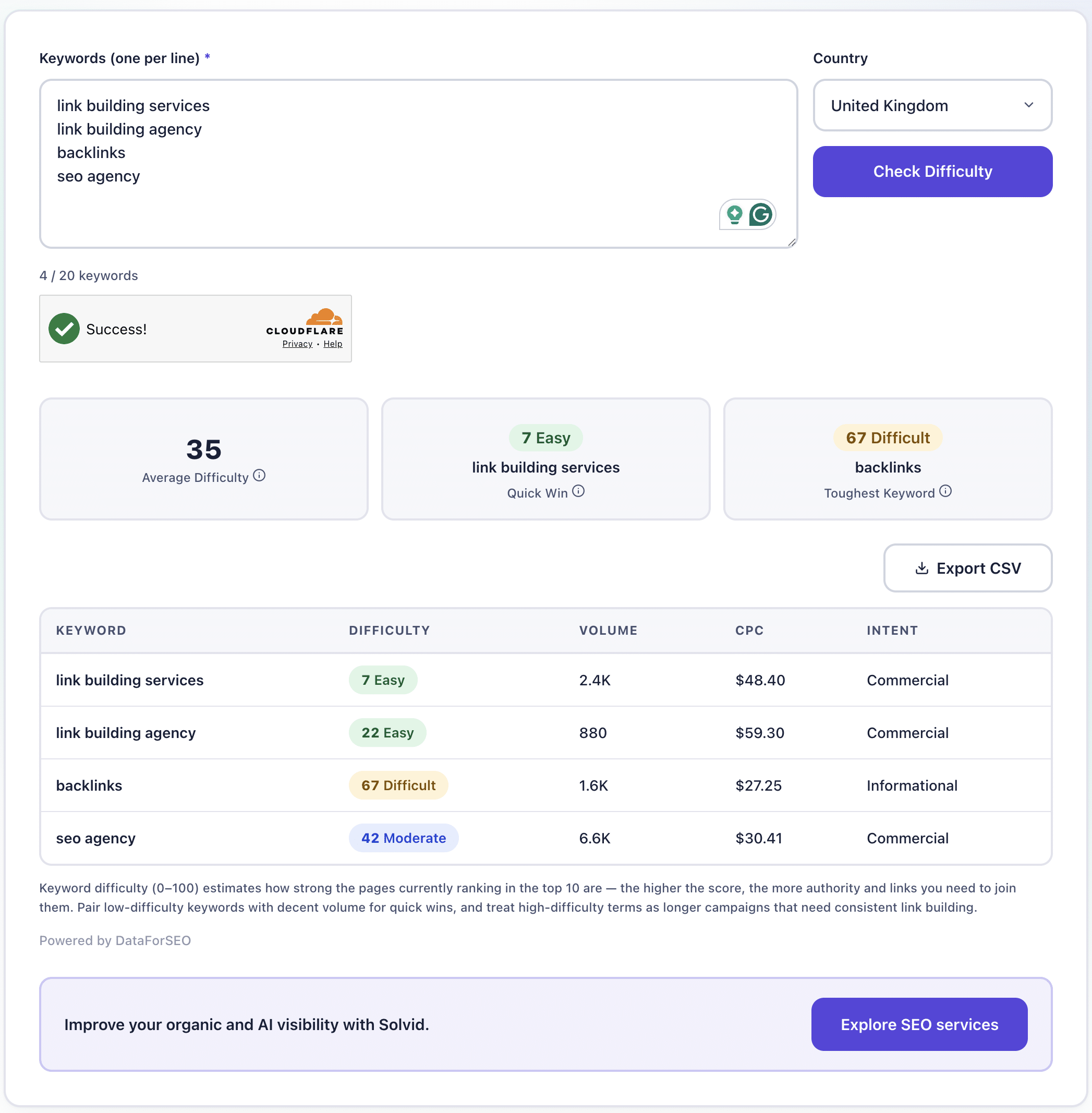
Keyword Difficulty Checker

How to use our keyword difficulty checker.

Paste your keywords

Add up to 20 keywords, one per line. A live counter tracks your list and duplicates are flagged before you submit, so nothing wastes a check.

Choose your market

Pick the country you want to rank in. The default is the United Kingdom. Difficulty is calculated against the pages ranking in that market, and the same keyword can score very differently between countries.

Run the check

All keywords are scored in a single pass. Each row returns a 0 to 100 difficulty score as a colour-banded pill with a plain label, from Very easy through to Very hard.

Sort, prioritise and export

Sort by difficulty, pull the realistic targets to the top and export the table to CSV. Pair the winners with the Keyword Rank Checker to see where you currently stand for them.

Who this keyword difficulty checker is for.

Anyone who works with SEO keywords can use this difficulty checker, including:

In-house SEOs

Triage a keyword list in bulk before committing pages to the content calendar

Content writers

Check the score before the brief, so effort goes where it can rank

Founders

Work out which terms a young site can realistically win this year

Agencies

Sense-check client keyword wishlists with data during scoping calls

Bloggers

Find the low-difficulty angles bigger publishers have not bothered with

Link builders

High difficulty scores signal keywords that need link support to move

eCommerce teams

Compare category term difficulty across every market you sell into

Marketing freelancers

Bulk difficulty data for client work without another monthly subscription

Why we built this Keyword Difficulty Tool.

Every SEO retainer Solvid has run in 11+ years starts the same way: a keyword list and a hard conversation about which of those keywords the client can actually win. Difficulty data is what makes that conversation honest. Without it, keyword planning drifts towards the terms the client wants rather than the terms the site can take.

We kept hitting the same annoyance: checking difficulty for a batch of keywords meant a paid seat on a full SEO platform, even when all we needed was twenty quick scores during a call. The free checkers that exist mostly handle one keyword at a time and bury the result under upgrade prompts.

So we built the checker we wanted: paste a list, get scores, see the quick wins, move on. It runs on the same class of data our own strategists use when we scope campaigns for clients.

A note on limits: A difficulty score tells you how strong the competition’s links are. It cannot tell you whether your content will be better, whether the intent matches your page, or how Google will treat your site’s topical authority. Use it to rank your options, then apply judgement.

How it works.

When you submit a list, our server sends the whole batch to leading SEO data providers in a single bulk difficulty request, rather than one call per keyword. Each score is derived from the link profiles of the pages currently ranking in your chosen market. For small checks of five keywords or fewer, we make one extra call to attach volume, CPC and intent to each row. Results are cached for several days per keyword and market, so repeat checks come back instantly.

Be aware that difficulty is an estimate and every toolmaker calculates it differently. The same keyword might score 35 in one platform and 50 in another, because each one weighs links, authority and SERP features its own way. The scores here are internally consistent, which is what matters: they will reliably tell you which keywords on your list are harder than which others.

Occasionally a keyword returns no score at all. That usually means there is not enough SERP data to model it, which is common for very new or very obscure terms. We show a clear blank rather than inventing a number.

Please Note:

1. This tool is provided free, as-is. Difficulty scores, volumes, CPC figures and intent labels are third-party estimates and vary between data providers. No score is an exact measure of competition.

2. A difficulty score is not a prediction or a guarantee of rankings. Actual results depend on your content, your site’s authority and how the SERP changes over time.

3. Results are cached per keyword and market for a short period, so a repeat check may return the cached score.

4. Your keyword lists are not tied to you or used for anything beyond serving the result.

FAQ.

Quick results on difficulty scores, how they are made and how to use them well.
What is a keyword difficulty score?
It is a 0 to 100 estimate of how hard it is to reach Google’s first page for a keyword. The score is calculated mainly from the strength of the pages already ranking, especially their backlink profiles and domain authority.
How many keywords can I check at once?
Up to 20 per check, pasted one per line. The tool dedupes your list, scores everything in a single pass and returns one table. When you check five keywords or fewer, we also add volume, CPC and intent for each.
Is a low difficulty keyword always worth targeting?
No. A keyword can be easy and useless if nobody searches for it or the intent does not match your business. The best targets combine manageable difficulty with real volume and intent that maps to a page you can build.
Can I check difficulty for other countries?
Yes. Choose your market from the country selector, with the United Kingdom as the default. Difficulty is market specific because the ranking pages differ by country, so always check against the market you actually want to rank in.
What scale does the difficulty score use?
Scores run from 0 to 100 and each result carries a plain band label, from Very easy up to Very hard. The labels matter more than the exact number, because a score of 43 versus 47 rarely changes the right decision.
Why do difficulty scores differ between tools?
Every provider calculates difficulty from its own link index and its own formula, so the same keyword scores differently across platforms. That is expected. Use one tool’s scores to compare keywords against each other rather than mixing scales.
Do I see search volumes too?
Yes, when you check five keywords or fewer we enrich each row with search volume, CPC and intent. Larger batches return difficulty only, which keeps bulk checks fast and lets you triage a long list before digging deeper.
What difficulty range should new sites target?

As a rule of thumb, sites with little authority should hunt below 30, established sites can compete up to around 60, and anything above that usually needs a serious content and link building programme behind it. We rank sites for hard keywords for a living, so if your targets sit at the top of the scale, talk to us.
UK SEO Agency

UK Address: 6 St. Davids Square, London, E14 3WA, United Kingdom

USA SEO Agency

US Address: 9100 Wilshire Blvd East Tower, Suite 333, Beverly Hills, CA 90212, United States

SEO Accreditation Large

Solvid is an international SEO and link building agency. Solvid is a registered trademark of Solvi & Heirs LTD, registered in England and Wales. Registered Address: 6 St. Davids Square, London, England, E14 3WA

VAT: GB 326425708

Reg: 09697233

020 7072 8788

hello@solvid.co.uk

Clutch
Trustpilot - Solvid
Solvid on LinkedIn
SEMRush partners - Solvid