Spam Score Checker

Check any domain’s spam score before you take a backlink from it or point one at it. Moz data plus our own, sophisticated AI-powered risk checks in one result. A thirty-second check here can save you from a placement you would regret for months.

What is spam score.

Spam Score is a metric created by Moz. It examines a domain against 27 signals that Moz found to be common among sites Google has penalised or banned: things like a very low link diversity, thin content, no contact information, unusual TLDs and suspicious anchor patterns. The more of those signals a domain shares, the higher its score, expressed as the percentage of similar sites that ended up penalised.

The crucial point, and the one most often misunderstood, is that Spam Score measures similarity, not guilt. A high score does not mean Google has penalised the site or ever will. It means the domain has features in common with sites that were. Some perfectly legitimate sites score in the medium band simply because of their niche or TLD. That is why the number should start a conversation, never end one.

In practice, spam score checks matter most around links. Before you accept a guest post placement, buy a link, respond to a link exchange offer or acquire an expired domain, a quick spam check tells you whether you are about to associate your site with a risky neighbourhood. It is also worth checking your own domain periodically, because a rising score can be an early sign of a link profile drifting in the wrong direction.

Here’s how the tool looks:
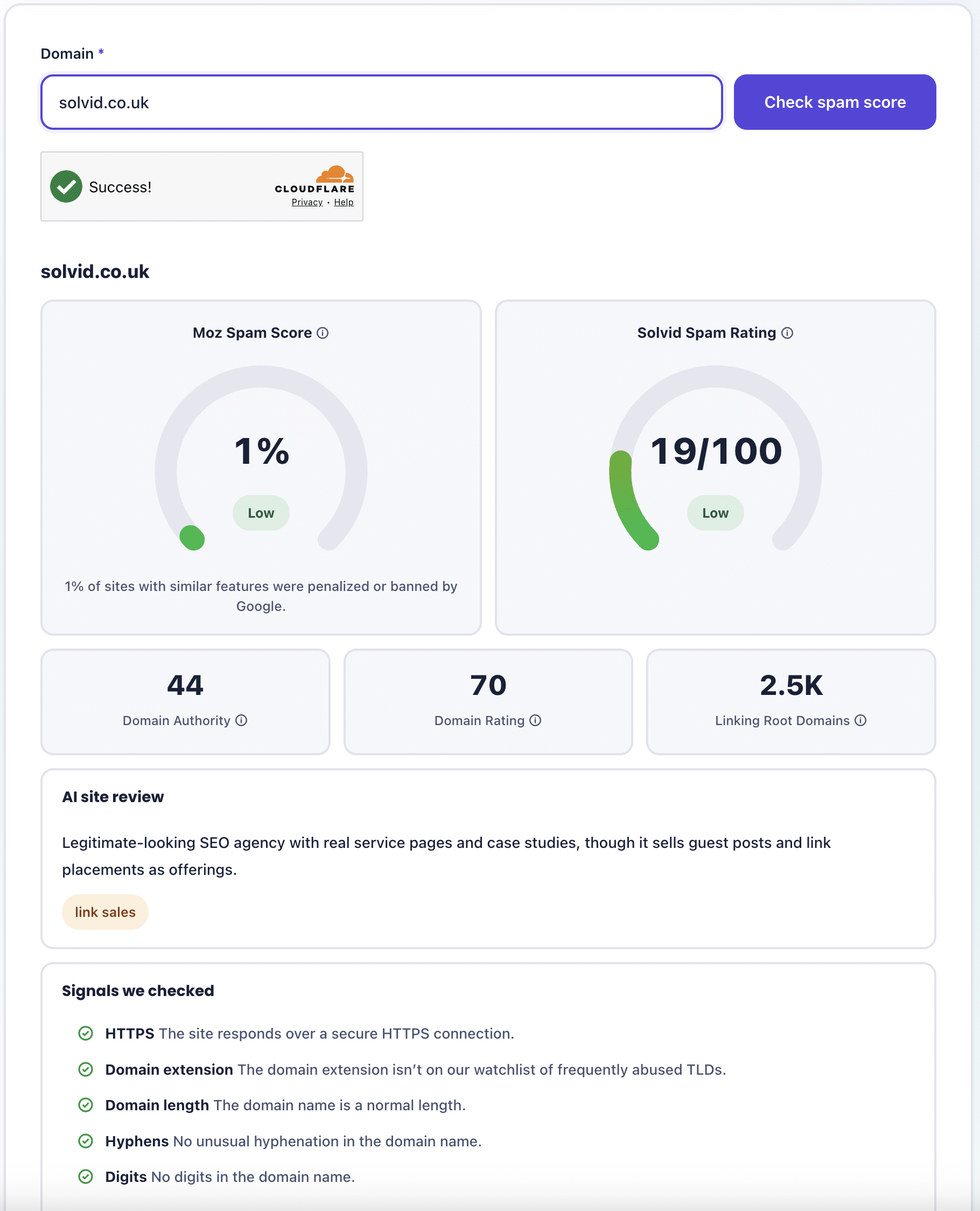
Spam Score Checker

How to use this spam score checker.

Enter the domain

Type or paste any domain. The tool strips protocols, www prefixes and paths automatically, so a full URL pasted from your browser works fine.

Run the spam score check

The tool queries Moz for the domain’s spam score, Domain Authority, Domain Rating and linking root domains, and runs our own AI-powered checks on the domain itself in parallel.

Read the gauges

Each check will result in two gauges: one showing Moz’s spam score on a scale of 1% to 100% (a higher percentage means a higher spam score) and one gauge showing Solvid’s own, AI-powered spam rating score on a 1 to 100 scale (a higher score means a higher spam rating).

Decide with context

A low score with clean signals is a green light. A high score is a prompt to look closer at the site’s content and links before you commit, not an automatic rejection.

Who this tool is useful for.

This spam score checker is useful for search marketers, AI visibility specialists, publishers, SEOs, and everyone who needs to cross-check the quality of a website.

Link builders

Screen every prospect before outreach so risky domains never reach the pitch stage

SEO managers

Keep a periodic eye on your own domain’s score and catch drift early

Marketing agencies

Add a fast spam check to client audits and prospect vetting workflows

Domain buyers

Check expired and aftermarket domains before inheriting their history

Publishers

Check how spammy the website is before quoting or linking to them

Technical SEOs

Identify linking domains that have a high spam score for a cleaner backlink profile

Outreach specialists

Have a clear spam score picture of the prospects you’re outreaching

Website owners

Check your website’s spam score and how you compare to the competition

Why we built the spam score checker.

Solvid has built 30,000+ backlinks over 11+ years, and every one of them passed a 10-point quality control process before placement. Spam signals are one of the first gates in that process: whatever a site’s authority numbers say, if it sits in a bad neighbourhood, we walk away. We run spam checks dozens of times a day, so publishing a free version was an easy decision.

The other reason is the traffic we see coming the other way. Businesses regularly arrive at Solvid after buying links from sites that looked fine on a single authority metric and turned out to be link farms. A basic spam check would have caught most of them. The signals are not secret; people just skip the step.

If your check turns up a worrying score, on a prospect or on your own domain, do not panic and do not start disavowing on instinct. A high score is a reason to investigate, and that investigation is precisely what our website audit service covers.

A note on high scores: A high spam score is not a verdict. It means the domain shares features with penalised sites and deserves a closer look. If it is your own domain, a manual review of your link profile and content will almost always explain the score, and most causes are fixable.

How it works.

The core data comes from Moz, which created and maintains the Spam Score metric. When you run a check, our server queries the Moz Links API for the domain’s spam score, Domain Authority and linking root domains. Moz calculates the score from 27 signals correlated with penalised or banned sites, and expresses it as a percentage band. We show the score exactly as Moz reports it, with the same low, medium and high bands Moz uses.

On top of the Moz data, we run our own heuristic checks server-side: domain length, hyphen and digit patterns, whether the TLD appears on lists of frequently abused extensions, and whether the site serves valid HTTPS. These checks are deliberately conservative. They produce warnings, never accusations, because a heuristic can only ever say “this pattern is sometimes associated with spam”, not “this site is spam”.

Two things worth stating plainly. Spam Score is Moz’s proprietary estimate, and Google neither publishes nor uses it. And if Moz has no link data for a domain, we still run the heuristics and clearly label the result as basic checks only, so you always know what the verdict is based on. Results are cached for 24 hours.

Please Note:

1. This tool is provided free of charge and as-is. We do not guarantee the accuracy or availability of the data, and results should not be treated as a definitive judgement on any website.

2. Spam Score is a proprietary Moz metric. It is not published or used by Google, and a high score is not evidence of a penalty or of wrongdoing by the site’s owner.

3. Our heuristic checks are warning-level indicators only. They flag patterns sometimes associated with spam; they never prove a site is spam.

4. Fair-use rate limits apply and results are cached for up to 24 hours. For a manual, human review of a worrying score, get in touch.

FAQ.

Common questions about spam score, what it does and does not mean, and how to act on it.

What is Moz Spam Score exactly?
Spam Score is a Moz metric that counts how many of 27 spam signals a domain shares with sites that Google has penalised or banned. It measures similarity to penalised sites, not wrongdoing. More shared signals mean higher risk.
Which is more reliable, Moz Spam Score of Solvid Spam Rating?
Both metrics are reliable but are never 100% accurate. Solvid’s Spam Rating uses an AI-powered engine to make a determination on top of the Moz Spam Score.
What spam score counts as safe?
Moz groups scores into bands: roughly 1 to 30 percent is low risk, 31 to 60 percent is medium and above 60 percent is high. Plenty of legitimate sites sit in the medium band, so always read the score in context.

Solvid’s Spam Rating uses the same scale.

What are the extra risk checks?
Alongside Moz data we run our own checks: unusually long or hyphen-heavy domain names, digits in the domain, top-level domains that are frequently abused, and whether the site serves valid HTTPS. Each check returns a pass or a warning.
Why does a new domain show nothing?
Moz needs backlink data before it can compute a Spam Score, so brand-new or barely linked domains often return no score. In that case the tool still runs our heuristic checks and labels the result as basic checks only.
What is Solvid Spam Rating exactly?
Solvid combines Moz’s spam metrics with our proprietary AI-powered algorithm to assess relevance, analyse site content and identify patterns and characteristics commonly used by spammy websites.
Is a high spam score a penalty?
No. Spam Score is not issued by Google and a high score is not a penalty or a verdict. It flags that a domain looks statistically similar to penalised sites, which is a prompt for a closer manual look, nothing more.
How do I reduce my spam score?
You cannot edit the score directly, but you can fix the signals behind it: remove toxic backlinks, improve thin content, add proper contact and about pages, serve the site over HTTPS and keep outbound links clean. The score follows the signals.
Should I disavow high spam score links?
Not automatically. Google says it ignores most spammy links, and disavowing carelessly can do harm. Disavow only after a manual review confirms a pattern of genuinely manipulative links, ideally as part of a proper link audit.
Is the spam score checker free?
Yes, completely. No account, no email, no trial. We apply fair-use rate limits and cache results for 24 hours to keep the tool fast and available for everyone.