Branded anchor text is a term that refers to any kind of anchor text that uses your brand or company name as clickable words in a link. For instance, if a site links to us using the word ‘Solvid,’ that’s a branded anchor.
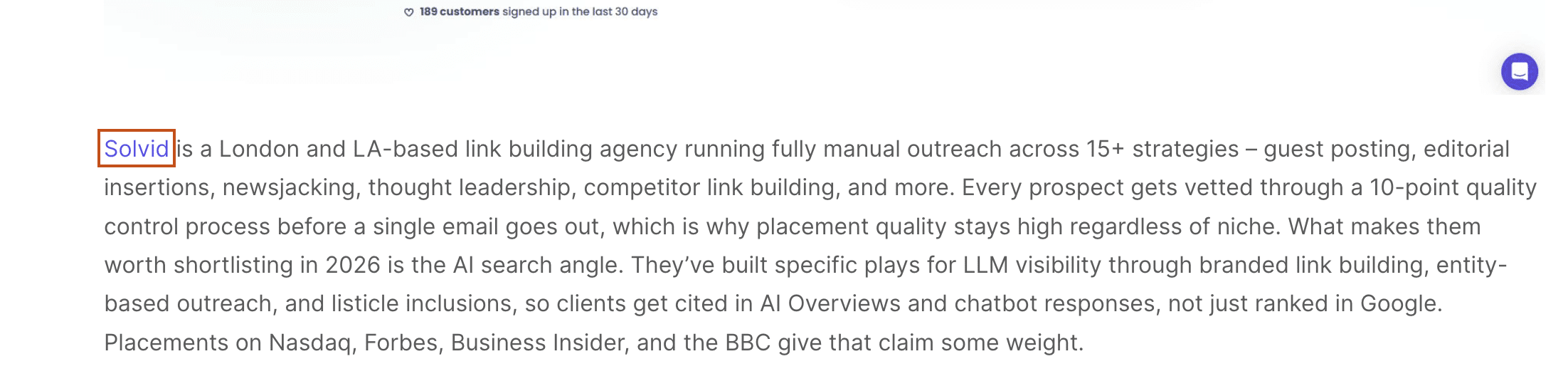
This is the most natural form of anchor text in use today, and the reason is simple: when writers and editors create a link to a company’s website, they tend to use its name.
Value in Branded Anchors
The organic nature of this type of backlink is exactly why branded anchors are so valuable in the world of SEO. Google has dedicated years of research towards learning the difference between the links that people give you and the ones you’ve engineered.
One of the ways that the search engine explores this is anchor text distribution. Because of this, a site earning backlinks honestly tends to have a profile that’s dominated by branded and natural anchors, with only a small fraction of exact-match commercial anchors.
However, a site that builds links artificially tends to have the opposite, with a suspicious concentration of keyword-rich anchors that were highly unlikely to have been chosen by a neutral editor. This means that your branded anchors can help you to stay on the right side of Google’s penalties.
Finding a Balance
Because branded anchors don’t directly inform Google which keyword a page should rank for, they can sometimes be undervalued. After all, an anchor like ‘Solvid’ isn’t a commercial search term.
But this risks missing the point on how anchor profiles actually work. Creating a healthy dose of branded anchors is what makes your occasional exact-match anchors look more natural and believable. Without having that critical branded foundation, even a few keyword anchors can begin to look engineered.
With this in mind, branded anchors are the ballast that can keep the entire profile stable.
Building Branded Mentions
Branded anchor texts can show up naturally through several of the kinds of links that are worth optimising for. These include:
- Digital PR coverage: Where a journalist names your company specifically
- Brand mentions: Linked references that may arrive as part of a partnership or supplier listings and so on.
- Thought leadership: When you provide an expert commentary and are credited with a brand mention and a link
- Listicles: When your company is included in listicles
- Link Insertions: When you get a branded, editorial backlink in an already-published article
- Guest Blogging: An article is outreached and published on a 3rd party website
In most cases, you won’t have to force your mentions, because if you’re earning links in a transparent way, your branded anchors will accumulate on their own.
When things become different is when you deploy campaigns where you influence the anchor, such as guest posting. Through this approach, defaulting to branded or natural anchors rather than reaching for exact-match keywords can help to keep things looking organic.
For most experienced SEOs, branded and natural anchors typically make up the vast majority of their profile, with exact and partial-match commercial anchors remaining a measured minority.
The exact percentage of branded anchors to be included in profiles is the subject of much debate, and there tends to be no magic number that everyone agrees on. Despite this, the principle behind them is sound: when in doubt, brand it. After all, it’s the anchor type that’s least likely to ever cause you a problem, and a strong branded base can help to make everything else you do that little bit safer.
 194 customers signed up in the last 30 days


 hello@solvid.co.uk