Commercial keywords are search terms that can help to point out to you that a searcher is in a buying frame of mind by searching for specific products or services with the intention of making a purchase, even if they’re not sure what they want to buy yet.
You can spot commercial keywords because of the queries that people use, such as “best link building services,” “Ahrefs vs Semrush,” or “link building agency reviews,” all of which tell you that the individual is evaluating their options, comparing, and moving towards a purchase decision.
At this particular stage in their buying journey, the lead is sitting between purely informational queries and outright transactional ones.
Understanding Commercial Intent
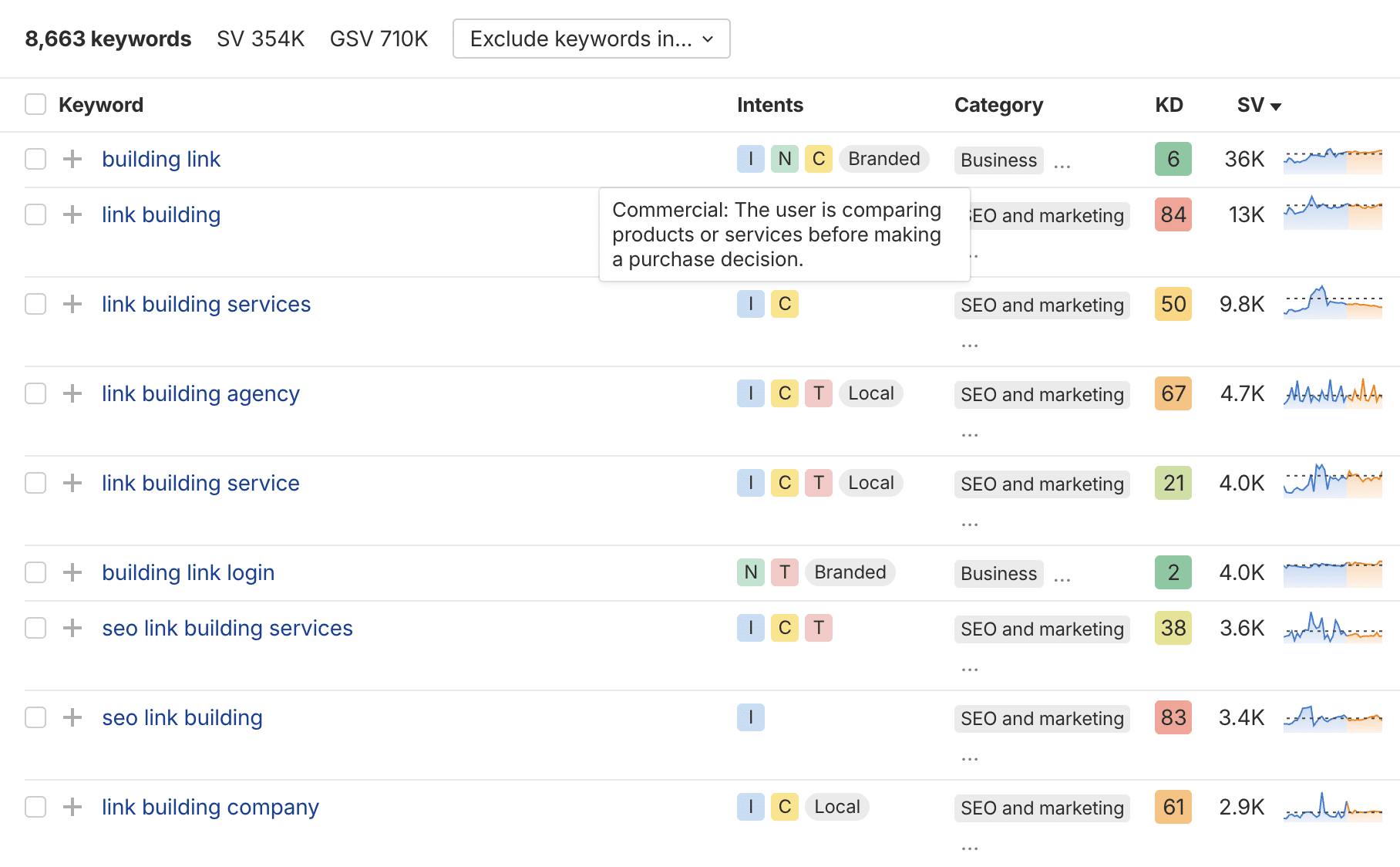
Getting an understanding of commercial intent is vital for your keyword strategy because it tells you exactly what the searcher actually wants and the type of page that’s most likely to satisfy their needs as a result.
This forms the heart of search intent, which is the idea that every query contains a purpose, and aligning your content accordingly is what can help to boost your rankings.
If someone is typing out a commercial keyword, they’re unlikely to be looking for a definition. Instead, they’re after comparisons, reviews, pros and cons, pricing context, and all the other types of information that can help them decide what to buy and where.
This means that if you create a thin introductory article to rank for these terms, you’re likely to lose your lead, no matter how much SEO excellence you add to the mix.
How to Use Commercial Keywords
If you’re a business, commercial keywords might well be the most value terms for you to target. This is because they sit exceptionally close to the point of purchase.
If a visitor is searching for “best CRM for small business,” then they’re likely to be much closer to buying one than somebody searching “what is a CRM,” and this means that the commercial-intent traffic you receive typically converts far better and is worth competing harder for.
The pages that target these terms, such as comparisons, ‘best of’ roundups, and review-style content, are generally far better at turning organic traffic into actual customers.
Knowing Your Keywords
There’s a useful way of knowing the difference between commercial and transactional keywords, even if the line has a habit of blurring here and there.
Commercial keywords are more about researching and comparing, while transactional keywords, like “buy” or “free trial” queries, signal that someone is ready to act right now on their interest.
Both are indicators of purchase intent, but they call for slightly different pages. One should be focused on comparison and evaluation content for commercial items, while the other should prioritise frictionless conversion paths for transactional ones.
When someone is ready to buy, any content that isn’t a CTA could be viewed as a pain point, and getting in the way of a would-be buyer could be disastrous for your conversion rates. With this in mind, mapping your pages to the right intent at each stage can really make your content strategy shine, driving revenue rather than just traffic.
Practical Applications
Words like “best,” “top,” “review,” “compare,” “versus,” and “alternatives” are good commercial signals, and checking to see what already ranks for these terms can help you to understand what Google thinks the intent is.
If the results you see are mostly comparison and review pages, then you’ll be able to tell that the keyword is commercial and your content should reflect that style.
Targeting these terms with genuinely helpful and honest evaluation content means you’ll be able to capture your leads at the moment they’re deciding on whether to make a purchase, which is exactly where you want to be.
 194 customers signed up in the last 30 days




 hello@solvid.co.uk