Domain Authority, which is often abbreviated to DA, is a metric that was created by Moz to predict how well a website is likely to rank in search results and is scored on a scale of 0 to 100.
When it comes to DA, the stronger Moz judges your site’s ranking potential, the higher the score you’ll have. The metric is based heavily on the quality of your backlink profile.
The chances are that you’re already aware of Domain Authority, and it may well be one of the most cited measures throughout the SEO landscape, to the point where people often use “domain authority” as a loose term to refer to a website’s general strength, even if they’re not specifically referring to Moz’s actual figures.
How is DA Calculated?
DA is calculated primarily from the data Moz gathers surrounding your links, and can include essential factors like:
- The quality and quantity of your backlinks pointing to a domain
- The number of unique referring domains
- How referring domains compare across Moz’s index of the web
Because DA is scored logarithmically, rising from 20 to 30 is much easier than moving from 70 to 80. This is because the higher you go, the harder each new point you add becomes.
This is important to keep in mind, because it means small improvements at the top of the scale can represent far greater gains in actual link authority compared to when you’re moving at the same rate lower down the ladder.
Using Domain Authority
Another important consideration to take is that Google doesn’t actually use DA and that it’s solely Moz’s own third-party estimate built on the platform’s data, meaning that it has no direct involvement in Google’s search engine rankings whatsoever.
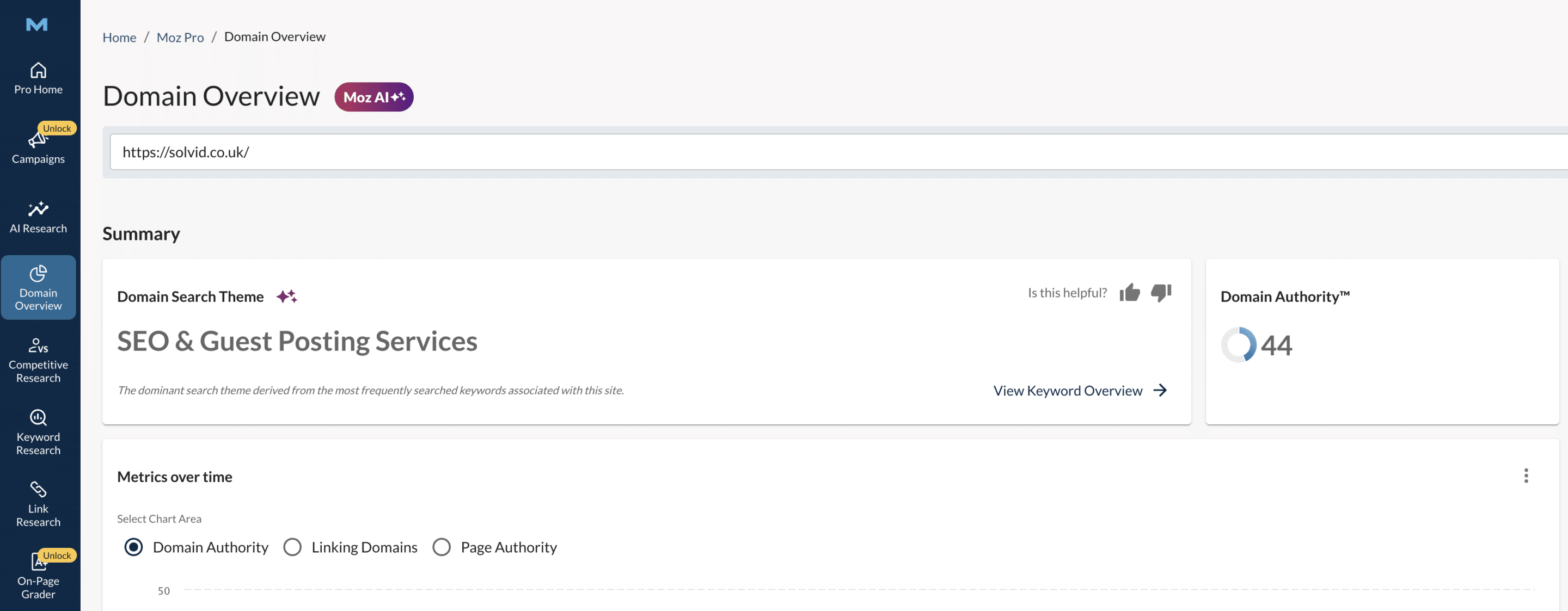
The same is true for the Domain Rating system used by Ahrefs and Semrush’s Authority Score, as well as every other similar metric. Instead, they all attempt to approximate authority as a wider concept, and while they’re useful for this reason, you should never treat DA as if it were a specific Google ranking factor.
When used sensibly, DA can be a useful comparative tool that offers you a quick read on the relative strength of your website or any other sites throughout the web. This can be useful for assessing link prospects, checking out competitors, or benchmarking your own progression over time.
If you’re looking at two potential websites to earn a link from, their DA scores provide a rough first filter. However, ‘rough’ is the operative word here. After all, Domain Authority should inform your judgment, not replace it entirely. Any site’s relevance and the quality of its content will matter just as much as its score.
Common Misconceptions
One frequently made mistake is when you prioritise Domain Authority as if it’s a be-all and end-all measure of quality. This can cause you to place too much emphasis on raising your own numbers or dismissing sites that fall short of certain DA thresholds.
Because of this, it’s always worth keeping in mind that a modest DA website in your niche can be worth more than a link from a high-DA site that has nothing to do with you.
It’s also important to remember that scores can sometimes be vulnerable to manipulative linking, meaning that a high DA won’t always guarantee a higher level of trustworthiness. This means that the best way to use DA and metrics like it is to combine them for a more complete insight rather than your sole form of guidance.
 194 customers signed up in the last 30 days




 hello@solvid.co.uk