Domain Rating, which is widely known as DR, is Ahrefs’ metric to measure the strength of a website’s backlink profile and is scored from 0 to 100.
DR is Ahrefs’ equivalent of Moz’s Domain Authority, and because the platform is so widely used for link-building purposes, the metric is a major tool when assessing the strength of a domain.
When someone says that a website is ‘DR 70,’ they’re referring to Ahrefs and its backlink profile rating of a website reaching a score of 70 out of 100.
How DR Works
What Domain Rating measures, precisely, is the strength of a domain’s backlink profile compared to every other website within Ahrefs’ index, based on the quantity and quality of the domains that are linking to it.
To clarify this further, DR is purely a link metric, and it doesn’t factor in content, traffic or relevance, only the backlink profile itself.
Websites can have a high DR from a strong link profile while ranking for very little, because Domain Ratings say nothing about whether the site’s content is actually any good or if its links are relevant to certain topics. Understanding this can help you to know how to use DR more effectively.
Like its peers, DR is calculated on a logarithmic scale, so this means that the jump from 20 to 30 is far simpler than that from 70 to 80. On a similar note, it’s a purely third-party estimate that Google has no involvement with.
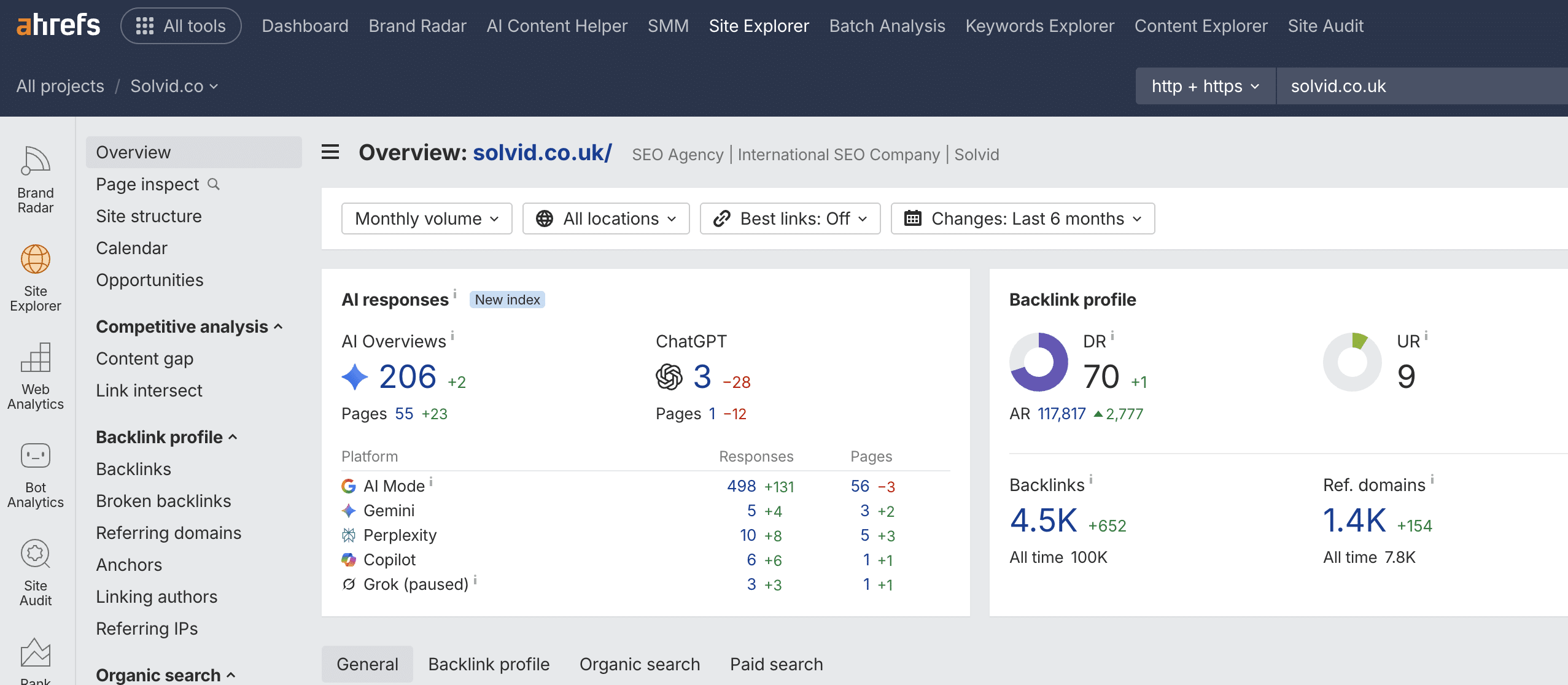
Like Domain Authority and Authority Score, your Domain Rating draws on different link indexes and formulas to generate its own rating for the value of links. There’s no right or wrong measure in any absolute sense, and they are merely competing approximations of authority.
Choosing one tool and staying consistent with it represents a key step towards making your comparisons meaningful, which is why many link builders choose to standardise on DR because they already spend the majority of their time using Ahrefs.
Using Domain Ratings
When it comes to link building, DR is a great metric for prospecting and prioritising your backlinks. While evaluating helps you to earn links, DR provides a quick read on how strong a potential linking site might be, which can help you to know where to focus your efforts and approach targets that can actually make a big impact.
Domain Ratings are also a common benchmark for tracking your own profile’s growth and comparing yourself to your rivals. After all, a rising DR over time powered by strong links represents a reasonable sign that your off-page work is creating appealing results.
When to Take Caution
You should never treat boosting your DR as a goal to aspire to in its own right. Likewise, don’t write off any lower DR site automatically. These metrics shouldn’t override the relevance of websites, and a DR 40 website that covers the same topics as you and is respected within your niche can provide a better link than an irrelevant DR 80 site.
It’s also worth remembering that DR can be inflated through manipulative linking, so a high number alone doesn’t necessarily mean that it’s trustworthy. With this in mind, you’re best off using DR as an easy filter that helps to inform your decision before looking at the actual links, relevance, and content before you make a decision.
By using it this way, you can make Domain Rating work for you as a perfectly practical metric as part of your wider link-building strategy.
 194 customers signed up in the last 30 days




 hello@solvid.co.uk