
Domain Authority vs Domain Rating vs Authority Score? The age-old question dividing SEO teams when it comes to measuring SERP success.
Research shows that at least 65% of SEO professionals prioritise at least one of these metrics when assessing the quality and value of an online domain.
However, navigating the alphabet soup of metrics can be confusing. If you ask ten different SEO experts whether they use Domain Authority vs Domain Rating vs Authority Score to assess website rankings, you’ll receive ten different answers.
This said, whether you’re tracking your own domain’s growth, looking to build backlinks, or spying on competitors, you’ll need to check at least one of these metrics to determine the site’s current ranking potential.
To help you cut through the noise, let’s take a deep dive into what each metric means, how they differ and when to use them in your own SEO strategy.
What is Domain Authority (DA)?
Domain Authority (DA) is the most common search engine ranking metric used by SEO professionals.
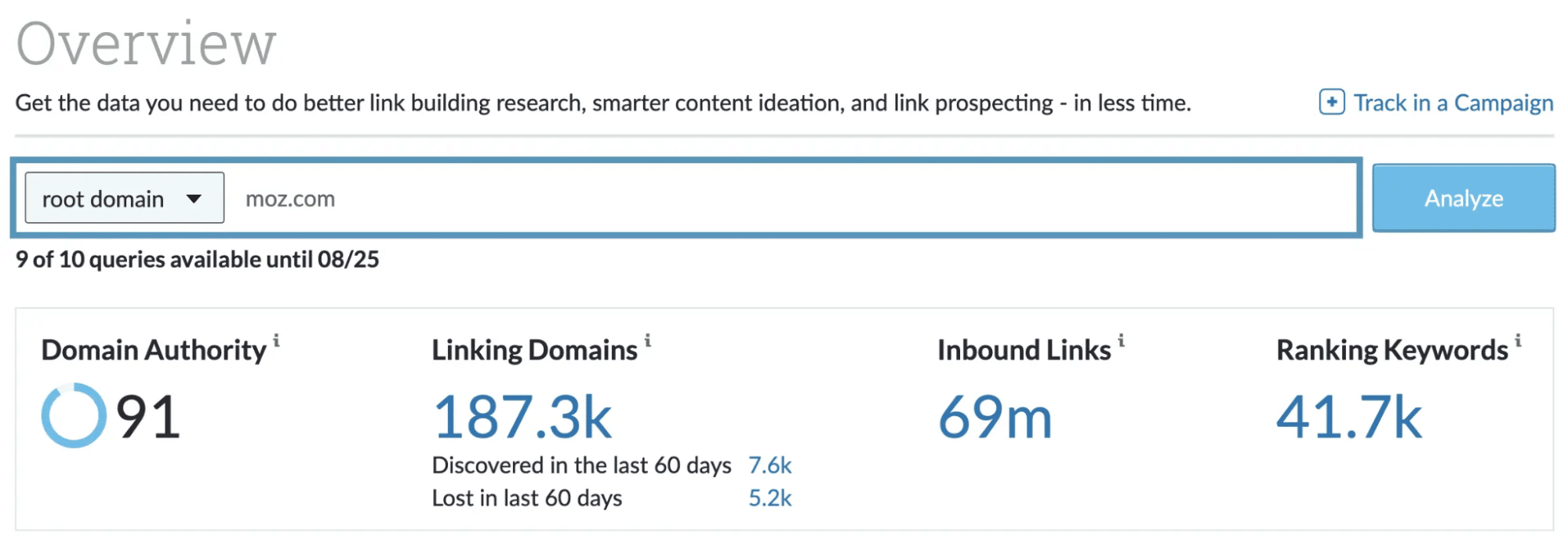
Developed by Moz, a domain’s DA score predicts how likely the website is to rank in SERPs compared to its direct competitors.
With a score ranging from 1-100, where 100 is the highest possible, websites aim to score 50 and above for a solid spot on search engine results pages.
How Does Moz Calculate Domain Authority?
A website’s Domain Authority is calculated using Moz’s machine learning algorithm.
While Domain Authority is not a legitimate Google ranking factor, Moz primarily focuses on a site’s ranking predictability.
From linking root domains, spam scores and backlinks to the quality of the websites providing those links, a DA score reflects the overall strength of a domain’s SEO profile and how closely its data correlates with high rankings.
This is why websites with a high-quality backlink profile full of authoritative and diverse placements tend to score higher than those with fewer backlinks and placements from low-quality websites.
What Does a Good Domain Authority Score Look Like?
Domain Authority is a relative metric. This means there is no universal ‘good’ or ‘bad’ score, only averages based on your target search niche.
The key here is to only compare a domain score to its competing sites in a Google search.
While all websites start with a DA score of 1, some industries naturally attract more links and less spam, such as large social media pages like Facebook and top-tier online publications like Forbes or Entrepreneur.
For smaller businesses in industries that attract fewer outbound links, a score of 30+ could be exceptional and beat close competitors for a top spot on SERPs.
This is the opposite for popular search industries, such as finance, that drive high-quality traffic and links. In the competitive search industry, a score of 70+ for financial link building could be considered impressive.
What is Domain Rating (DR)?
Domain Rating is often confused with Domain Authority because they are very similar.
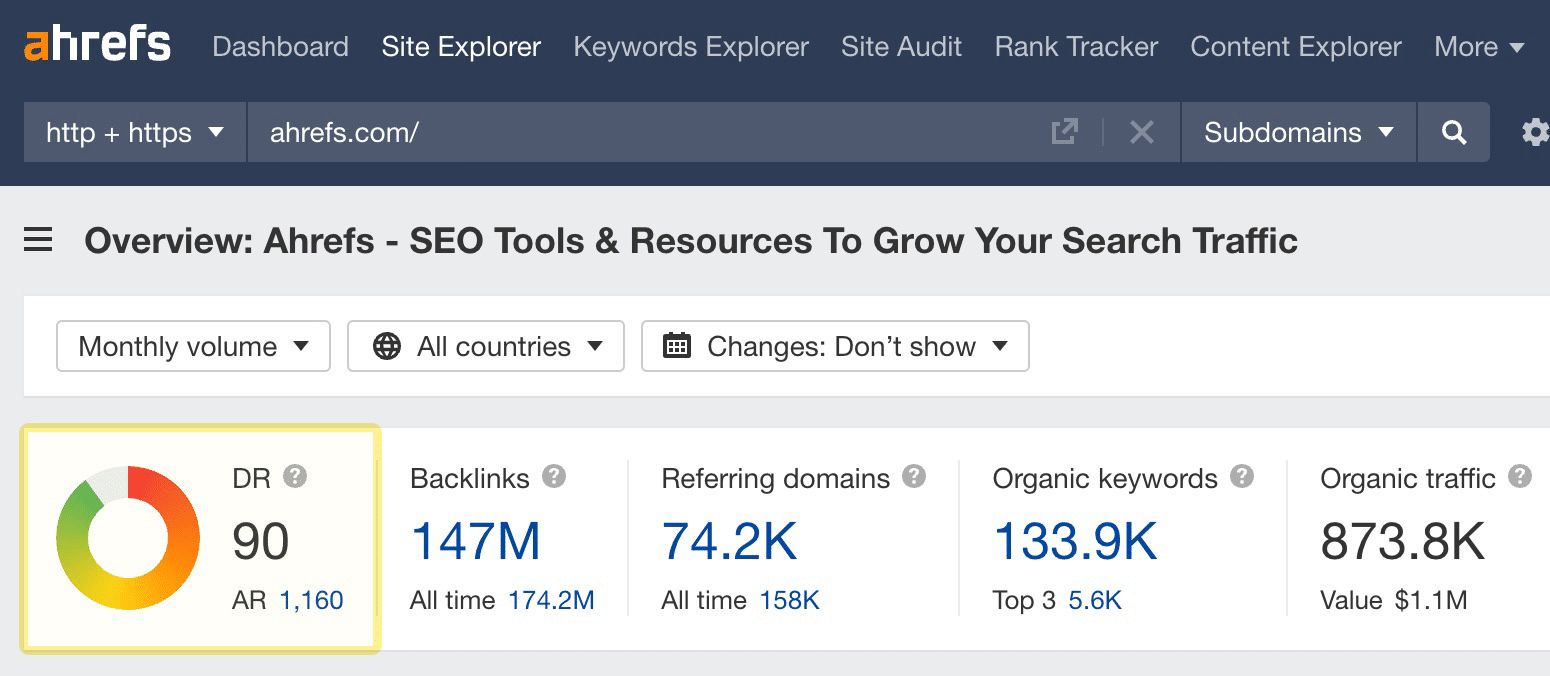
Domain Rating (DR) is a metric created by Ahrefs that measures a website’s strength and authority based on its backlink profile.
This metric is widely used not only to benchmark your own backlink profile health but also to monitor competitor backlink profiles and prospects for link insertion and guest posting.
Typically, Domain Rating ignores other ranking factors such as site traffic, content quality and user experience, which is why it is not an official Google ranking metric.
How Does Ahrefs Calculate Domain Rating?
Ahrefs relies solely on the domain’s link network to calculate Domain Rating.
Using a logarithmic scale scored from 1-100, Ahref’s formula not only considers a domain’s initial link portfolio, but also factors in how many other sites a domain’s backlink source links to.
For example, a link from a site that links to thousands of pages passes less DR value compared to a one-off link out from a high-authority domain.
What Does a Good Domain Rating Score Look Like?
Ahrefs’ domain metrics take several factors into account when calculating a site’s Domain Rating.
However, it mainly assesses the quality and quantity of the sites linking back to a website. Using the 100-point logarithmic scale, this makes it easy to score 10-20, while moving into 70+ requires an exponential number of backlinks.
Because of this, most domains aim for 40-60. This DR level suggests that the domain is well-established with a solid backlink foundation.
However, to truly achieve DR success, you need to build a backlink profile that earns a DR of 60+. This is the score most often awarded to major brands, established publishers and industry search leaders. These are the websites that often appear at the top of SERPs for competitive keywords and drive hundreds of high-quality, organic backlinks.
Keep in mind, though, that like DA, DR is all relative. If your score is equal to or higher than the sites you’re competing against, this is a key indicator that you’re performing well in your own search niche.
What is Authority Score (AS)?
Authority Score (AS) is a metric developed by Semrush and is designed, like DA and DR, to evaluate a domain’s SEO strength and domain quality.
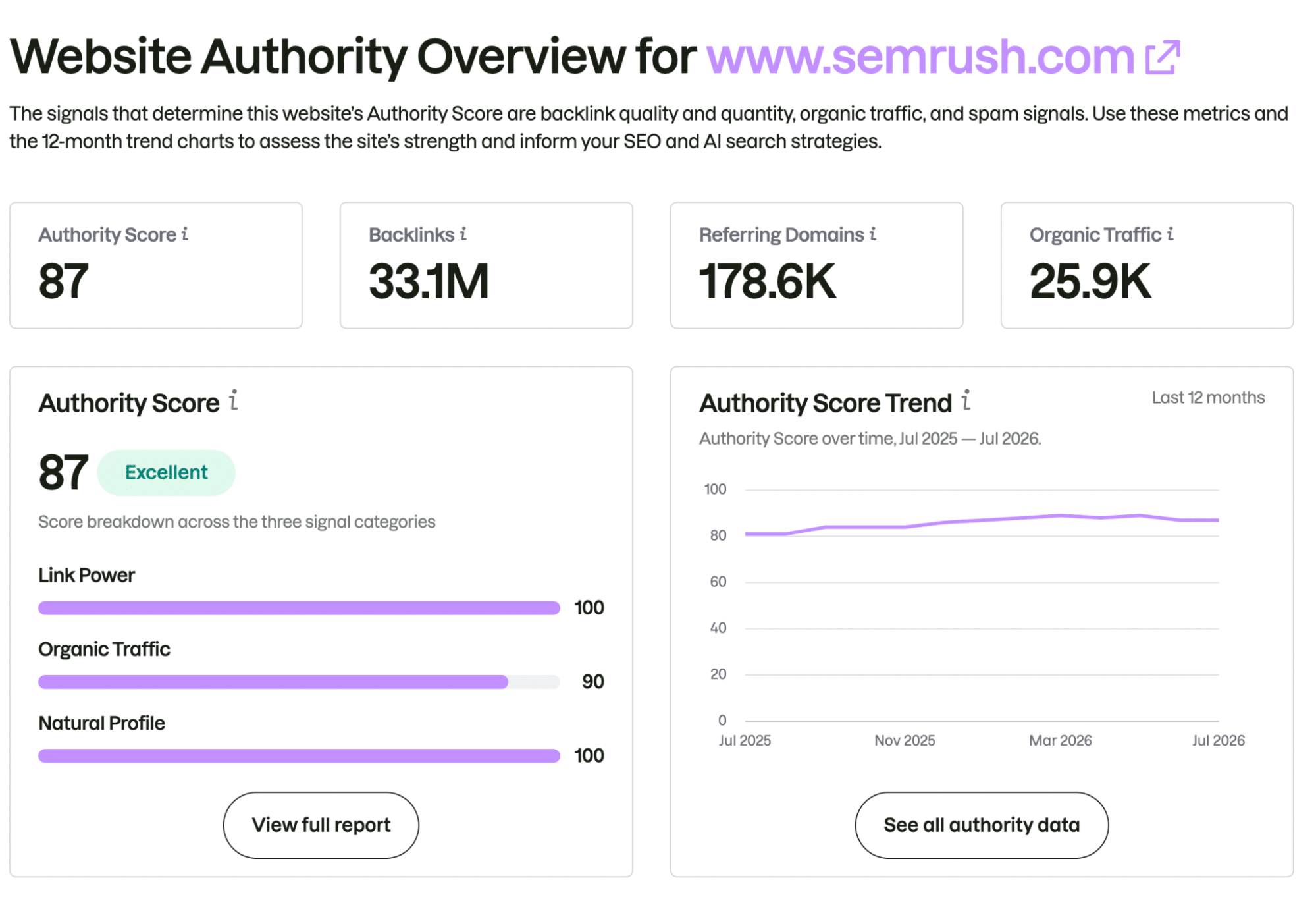
Following a system similar to DA and DR, AS ranks a domain on a scale of 0-100, with higher scores indicating that the site is more authoritative in Google Search results.
How Does Semrush Calculate Authority Score?
This is where thighs get a little different. Unlike Domain Authority and Domain Rating, a website’s Authority Score is calculated based on a number of SEO factors, rather than just the domain’s backlink profile.
Semrush uses a blend of three key elements to calculate AS:
- Backlink Profile: Like the other two, AS still takes a website’s link power into account, focusing mainly on the authority of the domains linking out to the target.
- Spam Flags: AS also focuses on website spam factors such as unnatural link growth, lack of organic rankings, and links from identical IP addresses. These are signs that the backlinks profile has been manipulated, resulting in a lower score.
- Organic Traffic: AS is the only metric that takes a website’s organic traffic into consideration when calculating its authority. Semrush evaluates the estimated number of monthly visitors the domain receives across search engines.
What Does a Good Authority Score Look Like?
Like DR, AS is calculated on a logarithmic scale. This means that there is no universal ‘good’ score. Instead, AS scores are relative to your industry and search competitors.
As a standard, most average-performing websites have a strong link profile and a steady traffic score between 40 and 60.
However, if you’re just starting out and aiming to rank for localised, niche keywords, a score of 20+ can indicate that your site is performing well.
Major search players like Amazon, eBay, BBC, and Wikipedia are most likely to score 80+ due to their massive link ecosystems and high traffic volumes.
Domain Authority vs Domain Rating vs Authority Score: Key Differences
While DA, DR and AS may all appear similar, they produce different scores for a reason.
From the update frequency to core focus, there are key differences between these tools that are important to know before you use them to determine the ranking of a target domain.
|
Key Differences |
Domain Authority (DA) |
Domain Rating (DR) |
Authority Score (AS) |
|
Score Scale |
|
|
|
|
Update Frequency |
|
|
|
|
Volatility |
|
|
|
|
Core Focus |
|
|
|
Why Does Each Metric Give Your Site a Different Score?
If you’re mapping Domain Authority vs Domain Rating vs Authority Score, it’s important to remember that these metrics cannot be directly compared.
While they all operate on a similar logarithmic scale, each metric has a different core focus and is built on a provider’s own proprietary index.
This means that Moz, Ahrefs and Semrush all crawl and catalogue the SERPs independently, which often results in a different set of backlinks, traffic and authority being counted for the same domain.
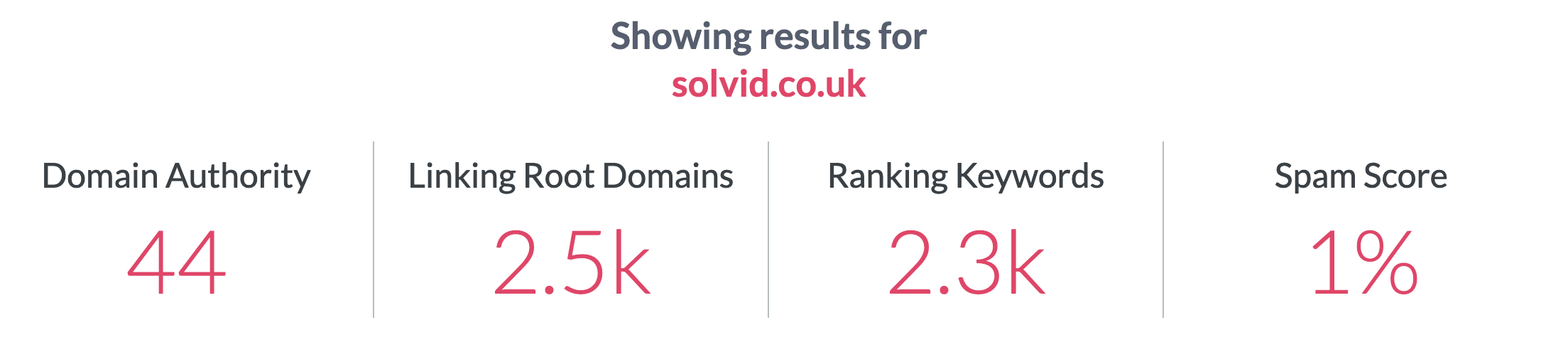
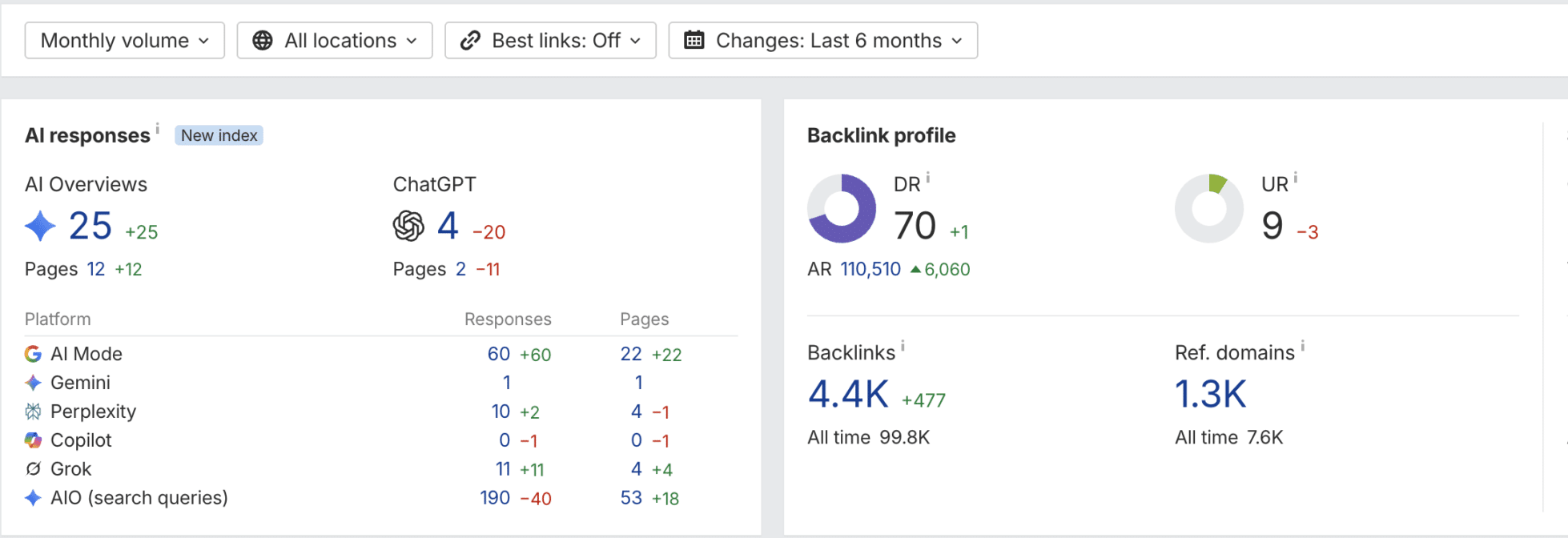
For example, https://solvid.co.uk/ has a DA score of 44, a DR score of 70 and an AS score of 32, which are all vastly different from each other.
Moz Domain Authority Checker
Ahrefs Domain Rating Checker
Semrush Authority Score Checker
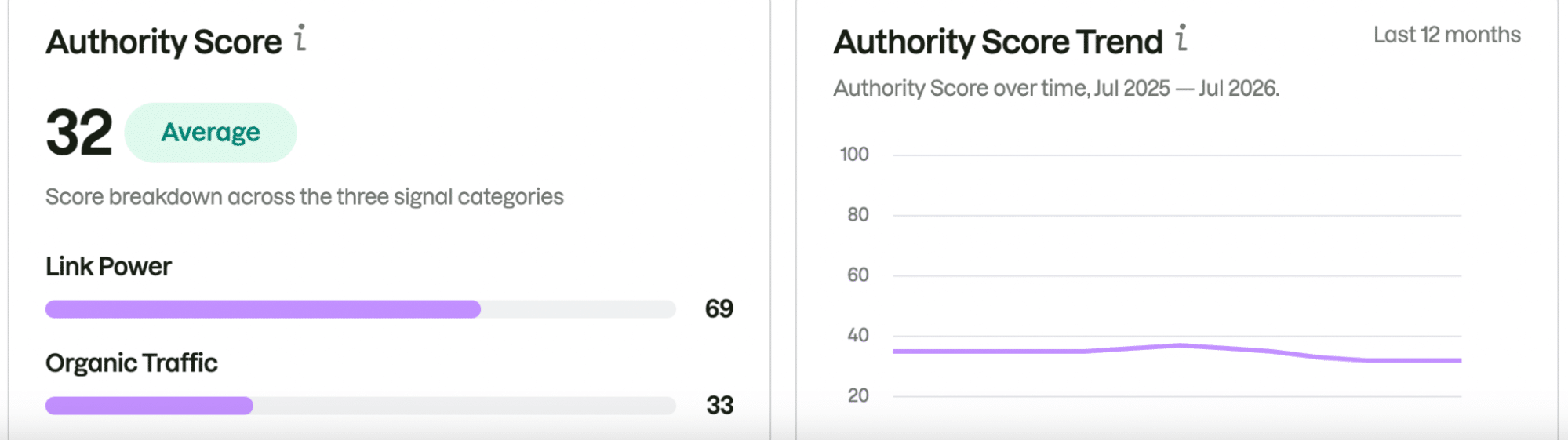
This fluctuation in score is down to each tool’s differing index size, crawl frequency and underlying algorithm, rather than any difference in the domain’s actual authority.
To avoid confusion, our advice is to choose a single tool and use it consistently to track domain rankings. This makes it easier to monitor progress over time and benchmark scores against competitors.
Which Metric Should SEOs Focus On in 2026?
The question is, which metric should your team choose to track in 2026?
While DA, DR and AS are all widely recognised ranking metrics across the SEO industry, choosing the best one for your needs is crucial.
While there isn’t a single ‘best’ metric to track and monitor domain health, you can narrow down your options based on what you’re trying to achieve.
Whether you’re assessing a domain for link building or monitoring growth for client reporting, we have you covered.
Let’s take a closer look at what each metric is best used for and the pros and cons of each when crafting a winning SEO campaign.
Domain Authority: Best For Long-Term Benchmarking
If you’re monitoring a domain’s growth long-term, Domain Authority tends to be your safest choice of metric to track.
It’s no secret that Moz was one of the first tools to popularise domain authority scoring. This means that DA is a well-known metric, referenced by many of your clients/stakeholders.
For this reason, opting to benchmark client success and report growth using DA-powered SEO audit ensures that communication between your team and the client remains uncomplicated and free of lengthy explanations.
Pros of Using Domain Authority
- Widely recognised by clients and stakeholders for simple reporting.
- Useful for tracking a single domain’s growth over time.
- Well-suited for long-term benchmarking due to its logarithmic scale, measuring sustained authority growth rather than short-term link spikes.
Cons of Using Domain Authority
- Slower update frequency than DR and AS.
- While more established, Moz’s index is still smaller than those of Ahrefs and Semrush, meaning DA checkers could miss new or smaller sites during crawling.
- The lack of an update frequency makes DA less useful for making link-building decisions.
Domain Rating: Best For Link Building & Competitor Backlink Analysis
If you’re purely looking to track a domain ranking for link building, Domain Rating is the best metric for your team without a shadow of doubt.
DR provides your team with a window into how strong a domain’s link profile is. With such a large, regularly refreshed index, Ahrefs continues to deliver real-time backlink data that can be used to make rapid decisions about prospective sites.
This is why DR is most commonly used by link-building professionals to secure the best prospects for outreach.
Pros of Using Domain Rating
- Access to real-time backlink data due to frequent updates.
- A well-maintained index makes it reliable for spotting new links quickly and identifying lost links.
- Known for backlink monitoring, making it the perfect targeted metric for outreach campaigns.
Cons of Using Domain Rating
- While a backlink focus is powerful for link builders, other SEO benchmarks are tricky because DR fails to account for spam signals and organic traffic when ranking a domain.
- Hard to establish whether a high ranking comes from low-quality or manipulative links.
Authority Score: Best For All-Round SEO Health Checks
Semrush’s Authority Score is widely known as the ‘holistic’ approach to domain monitoring.
As the only metric of the three that accounts for multiple factors when ranking a domain, this blended algorithm is perfect for SEOs conducting an all-around domain health check.
With the ability to cross-reference links against spam signals and traffic data, AS is also a great metric to use when taking a backlink audit. If the goal isn’t “how many links” but “are these links actually helping or hurting me,” AS helps SEO teams decide what to disavow.
Pros of Using Authority Score:
- Takes links, spam signals and organic traffic into account when ranking a domain.
- Useful for flagging manipulated link profiles and high spam scores before prospecting.
- Quickly gaining recognition as a top metric to use for SEO monitoring in 2026.
Cons of Using Authority Score:
- With a number of factors influencing the AS score, SEOs find it harder to determine exactly what is driving the change in the score.
- Less established than DA and DR as a ranking metric.
- While Semrush’s index may be among the largest, it differs from competitors’, making its results difficult to compare and translate across tools.
Beyond DA, DR, and AS: Metrics That Matter More
While DA, DR and AS are all brilliant indicators of a domain’s strength, they are not the only metrics you should rely on when crafting a winning SEO campaign.
DA, DR and AS are great starting points, but relying on them alone could give you a skewed picture of a domain’s true SEO performance.
To complement these, you need to include metrics during the planning stage that track organic search performance as well as link-building potential.
Let’s have a closer look at some of the key metrics that your SEO campaign may be missing in 2026:
Organic Traffic: This remains the strongest indicator of overall SEO health. If a domain has a steady or rising flow of internet traffic, this suggests the website is active, engaging, and ranking highly in SERPs. Better still, you can also use Moz, Ahrefs or Semrush to track this metric alongside DA,DR and AS.
Referring Domains: Try not to focus all your attention on a site’s total number of backlinks. Instead, map a website’s referring domains. This offers a deeper insight into the quality of a link profile. Remember, a handful of high-authority referring domains is generally more valuable than hundreds of links from a single low-quality source.
Keyword Ranking: Mapping keyword rankings is key to determining whether a site’s SEO efforts are translating into actual SERP positions on Google, rather than just DA/DR authority growth. The best domains not only have strong link profiles, but their on-page content continually ranks for competitive keywords and appears regularly in AI Overviews.
Solvid’s Recommendation For 2026
In 2026, the most successful SEO strategies are crafted around consistency. This means choosing metrics that are well-established, provide real-time updates, and are targeted to your team’s individual goals.
For this reason, Domain Rating remains the go-to for day-to-day link-building and outreach work, thanks to its fresh data and large index.
However, as Semrush’s Authority Score continues to become more popular, its ability to map spam signals could be increasingly valuable, especially as search engines become more focused on eliminating manipulative link schemes.
While Domain Authority is most established, this does not necessarily mean that Moz’s metric has the upper hand. However, it’s worth keeping DA in mind as a key benchmark for legacy reporting and client-facing communications.
This said, while many use tools such as Moz, Ahrefs, and Semrush to settle the Domain Authority vs Domain Rating vs Authority Score debate, most forget that these platforms can also be used to track key metrics such as referring domains, organic traffic, and keyword rankings.
The best SEO teams create campaigns with more than one metric in mind. While it’s important to stick with and settle on either DA, DR, or AS for accurate benchmarking, this does not mean other SEO metrics, like keyword ranking, are off-limits.
The more you diversify your research, the better the SEO outcome.
FAQ
How Do I Calculate My Domain Ranking?
While there is no official ranking score provided by Google, you can use tools like Moz, Ahrefs and Semrush to calculate the success of your website in relation to its competitors.
While Domain Authority and Domain Rating focus mainly on a domain’s backlink profile, Semrush’s Authority score takes spam flags and traffic generation into consideration, too.
To check your score, simply enter your domain into your chosen free checker, and the tool uses its own proprietary index of the web to generate an automatic score from 0-100.
Is a Higher Domain Authority, Domain Rating, or Authority Score Always Better?
DA, DR and AS are all relative metrics. This means there is no universal ‘good’ or ‘bad’ score, only averages based on your target search niche.
The key here is to only compare a domain score to its competing sites in a Google search.
While all websites start with a DA score of 1, some industries naturally attract more links and less spam, such as large social media pages like Facebook and top-tier online publications like Forbes or Entrepreneur.
For smaller businesses in industries that attract fewer outbound links, a score of 30+ could be exceptional and beat close competitors for a top spot on SERPs.
Major search players like Amazon, eBay, BBC, and Wikipedia are most likely to score 80+ due to their massive link ecosystems and high traffic volumes.
Can I Compare My Domain Authority Score to My Domain Rating Score?
If you’re mapping Domain Authority vs Domain Rating, it’s important to remember that these metrics cannot be directly compared.
While they all operate on a similar logarithmic scale, each metric has a different core focus and is built on a provider’s own proprietary index.
This means that Moz, Ahrefs and Semrush all crawl and catalogue the SERPs independently, which often results in a different set of backlinks, traffic and authority being counted for the same domain.
This fluctuation in score is down to each tool’s differing index size, crawl frequency and underlying algorithm, rather than any difference in the domain’s actual authority.
How Often Should I Check My DA, DR, and AS Scores?
For the most accurate tracking, we’d recommend checking your DA, DR and AS scores monthly.
For securing link placements in particular, it’s best to check the DA, DR, or AS of a domain as close to the time of securing the backlink as possible to account for any last-minute shifts.
Do Google Rankings Depend on Domain Authority, Domain Rating, or Authority Score?
The short answer is no. Google does not consider Domain Authority, Domain Rating or Authority Score a direct ranking factor.
DA, DR and AS are developed independently by Moz, Ahrefs and Semrush, meaning that the metrics you see aim to correlate with Google’s ranking potential, rather than determine it.
It’s best to treat DA, DR, and AS as indicators of ranking success rather than as ‘causes’. A high score for one of these metrics suggests that the domain is authoritative, trustworthy and likely to have a robust backlink profile.
Which Metric Is Best for Assessing a Guest Post or Backlink Opportunity?
If you’re looking to track a domain ranking for link building or guest posting, Domain Rating is the best metric for your team.
DR provides your team with a window into how strong a domain’s link profile is. With such a large, regularly refreshed index, Ahrefs continues to deliver real-time backlink data that can be used to make rapid decisions about prospective sites.
With Ahrefs, you have access to real-time backlink data thanks to its frequent updates, and its large, well-maintained index makes it reliable for quickly spotting new links and identifying lost ones.
 194 customers signed up in the last 30 days




 hello@solvid.co.uk