Skip to content
Fintech · crypto · SaaSReady to outrank your competitors?Talk to a specialist who already knows your market. Trusted by Freedom24, KuCoin, Bitget and Hostinger.Get in touch today
London · Los AngelesTwo cities. One team behind your growth.
London · HQ
6 St. Davids Square, E14 3WA · 020 7072 8788
Los Angeles
9100 Wilshire Blvd, Suite 333, Beverly Hills
Get in touch

Keyword research services · since 2015

Keyword research
services built for
Google and AI.

Intent-mapped keyword research services that set the direction for everything else in your SEO: discovery, clustering, competitor gaps, SERP analysis and AI search prompts, delivered as one working document your content team can start from the next day.


100,000+
Backlinks built
2M+
Keywords ranked
100+
Satisfied clients
11+ years
In SEO, since 2015
Brands that trust our SEO
Hostinger LogoKucoinFreedom24 logoMetaTrader 5 LogoBitget logoThe Access Group logoEpos NowWealthify logoPayouts.com logoThe Open University logoPageGroup logoLookers logo
What are keyword research services?

Keyword research services, explained.

A keyword research service works out which searches your site should try to win over the next 6, 12 or 24 months, and in what order. That decision feeds every other one: which pages to write, which to optimise, where to point links, and which topics to leave alone. Done well, it is a documented plan with intent, difficulty and commercial value attached to every term. Done badly, it is a column of high-volume phrases exported from a tool, and the writer has to guess at the rest.

200–20,000
keywords per project, sized to the site
Up to 10
competitors mapped for gaps

The work has changed a great deal in the last few years. Third-party volume figures have drifted from the impressions you can see in Search Console. Results pages are far more mixed, with AI Overviews, local packs, video carousels and Reddit threads taking space that used to go to ten blue links. ChatGPT, Gemini and Perplexity answer questions with no volume figure attached to any of them. So a keyword plan written in 2026 has to weigh SERP features, intent that shifts month to month, AI citations, the branded and non-branded split, and the line between informational and commercial queries at a much finer grain than the old head, mid-tail and long-tail model allowed.

We have run keyword research for SEO since 2015, for hundreds of sites across fintech, SaaS, crypto, hosting and most other B2B categories. What you receive is a strategy rather than a list: prioritised clusters, intent labels, a target page for every keyword, and briefs ready to hand to a writer. You will know what to publish, in which order, and the reasoning behind each choice.

Why Solvid

Why teams choose Solvid as their keyword research agency.

Most keyword research dies in a spreadsheet: too long, nothing prioritised, no relation to how content gets commissioned. Ours is built backwards from the content team. Each cluster maps to a page or a brief, and each brief carries the target keyword, supporting keywords, recommended format, SERP notes and intent notes. The team gets a queue they can work through rather than 10,000 rows of noise.

The same research also covers visibility in ChatGPT, Gemini, Perplexity and Google AI Overviews. Questions put to an assistant are longer, more conversational and more specific than the equivalent Google query, so we collect them separately, find the answers where your brand is missing, and write briefs designed to earn citations as well as rankings. Freedom24's AI visibility rose 447% over 48 months with us, and that started with knowing which prompts mattered. There is more in our guide on how to rank in AI search.

Intent-first methodology

Every keyword is labelled by intent (informational, navigational, commercial, transactional) and by the SERP type Google is rewarding, so each query is matched to the right kind of page before anyone writes a word.

Topical clustering, not flat lists

Keywords are grouped into clusters with a pillar page and supporting pages already mapped, which means the deliverable doubles as a content programme.

AI search and LLM queries

We research the prompt-style questions asked in ChatGPT, Gemini, Perplexity and Google AI Overviews alongside classic Google searches, and check which answers currently cite your competitors instead of you.

Competitor gap analysis

Up to 10 direct competitors are mapped in Ahrefs to find the keywords bringing them traffic that you do not yet rank for, ordered by how realistic each gap is to close.

SERP-by-SERP analysis

For every priority keyword we scrape or screenshot the live results page to see who ranks, which content format is winning and which features (snippets, PAA, AI Overview, video) take the clicks.

Tool-agnostic data

Ahrefs is the backbone, cross-checked against Semrush, Search Console, Google Keyword Planner and forum mining, because every tool misses queries the others catch.

What's included

What's included in our keyword research.

01

Discovery and seed expansion

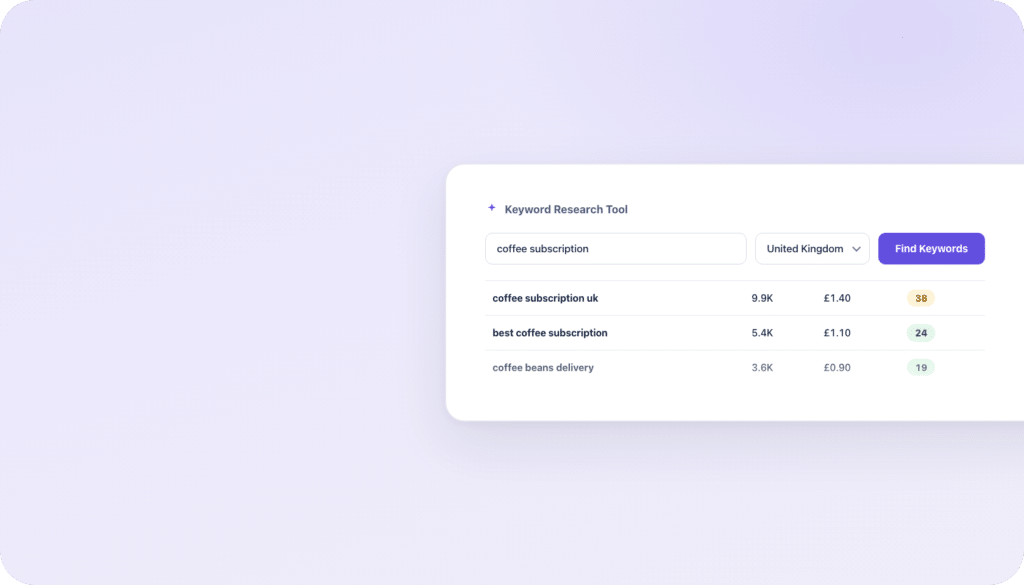
We begin with your seed terms, your current rankings, your competitors, the language your customers use on calls and in reviews, and the prompts they type into AI assistants. From there we expand the set in Ahrefs, then widen it further with Semrush, Google Search Console, Keyword Planner, AlsoAsked, AnswerThePublic, Reddit, Quora and the trade forums specific to your sector. For a quick sense of the starting point, our free keyword research tool gives volume and related terms with no signup.

02

Search intent classification

Each keyword is tagged by intent (informational, navigational, commercial investigation, transactional) and by the SERP type Google returns for it: product page, blog post, listicle, tool, video, calculator or comparison. That tag decides the content type in the brief, and it is checked against the live results rather than guessed from the wording.

03

Competitor keyword gap analysis

We pull the ranking keywords of up to 10 direct competitors, intersect them with your current visibility and list the gaps. Each one is scored on traffic potential, keyword difficulty and commercial relevance, so a low-volume term one step from a purchase can sit above a big informational head term in the queue. Our keyword difficulty checker uses the same Ahrefs difficulty scale you will see in the deliverable.

04

Topical clustering, keyword mapping and cannibalisation

Keywords are grouped into clusters, each with a pillar page and supporting content. We then map every cluster to an existing page (to optimise) or a new page (to brief). This is also where cannibalisation gets caught: if two of your URLs trade places for the same query, or a blog post outranks the service page it should be feeding, the map records one target per keyword and a fix for the other page, usually a consolidation, a redirect or a rewrite around a different cluster.

05

SERP feature and intent analysis

For the high-priority keywords we look at the results page itself: featured snippets, People Also Ask, AI Overviews, image packs, video carousels and local packs. The aim is to see which surfaces take the clicks and what shape your content needs, including where FAQ markup or a comparison table is needed to earn a snippet.

06

AI search and LLM query research

We discover the prompt-style questions being asked in ChatGPT, Perplexity, Gemini, Claude and Google AI Overviews, record which sources each assistant cites, and identify the topics where your brand does not appear. Those gaps become briefs written to be quoted, with clear definitions and sourced figures the models can lift.

07

Commercial intent and revenue mapping

For ecommerce, SaaS and lead-gen sites we tag keywords by funnel stage and estimate commercial value where the data allows. The priority order then leans towards the keywords likely to produce pipeline rather than the ones that produce the biggest traffic chart.

Who it is for

Who keyword research is for.

Standalone keyword research suits any team that wants a documented plan before it commits budget to content. Founders launching a new site or a new category who need to know what to target first. In-house marketing teams with writers available but no framework telling them what to write. Content agencies that need a research deliverable to brief against for their own clients. SaaS and ecommerce brands moving into a new vertical or a new country who need a fresh keyword map for it. SEO consultants who want a delivery partner for the research side.

It also suits brands with a large, sprawling site and no clear view of what is working. A full project regularly surfaces hundreds of pages to optimise, consolidate, redirect or remove, and that clean-up alone often pays for the research.

If you are on one of our SEO retainers, keyword research is part of the engagement from £2,500 a month and is refreshed every quarter. The standalone service exists for teams that want the research without the rest of the SEO programme, and it pairs well with our on-page SEO services when the mapped pages need rewriting.

Our approach

How we run a keyword research engagement.

What to expect

A standalone keyword research project usually takes 3 to 4 weeks for a focused brief and 6 to 8 weeks for a full site-wide strategy. You can hand cluster briefs to a content team the day after the walkthrough call. Content programmes built on sound research tend to show organic traffic gains 3 to 6 months after the first articles go live, and the growth compounds from there as clusters fill out.

  1. 01

    Review the brief and current position

    Goals, target countries, competitors, commercial priorities and the keywords you already rank for. We take access to Search Console, GA4 and any keyword data you hold, and audit what the site has published so far.

  2. 02

    Benchmark rankings

    Before any new research, we record where you and your named competitors currently rank for the terms that matter. The benchmark becomes the baseline every later report is measured against. Our free rank checker shows the same view for a handful of terms.

  3. 03

    Research and expand

    We build the keyword universe from seed terms, competitor rankings in Ahrefs, customer language and AI prompts. This stage typically yields several thousand candidates before filtering, which is deliberate, since a narrow starting set is how good long-tail terms get missed.

  4. 04

    Filter and cluster

    Candidates are filtered by intent, traffic potential, difficulty and SERP feature mix, then grouped into topical clusters. High-priority terms get a manual SERP review to confirm the content format before they go into a brief.

  5. 05

    Map to pages

    Every cluster is assigned to an existing URL or a new page, with a single primary keyword per page so nothing competes with itself. The map is prioritised into a 90-day, 180-day and 12-month content roadmap.

  6. 06

    Identify gaps and hand over

    The competitor gap matrix and AI citation gaps are finalised, then you get the master spreadsheet, the written strategy summary and a live walkthrough call with the people who built it. Briefs for individual clusters can be added on request.

Keyword research for AI search

Research the prompts,
not only the keywords.

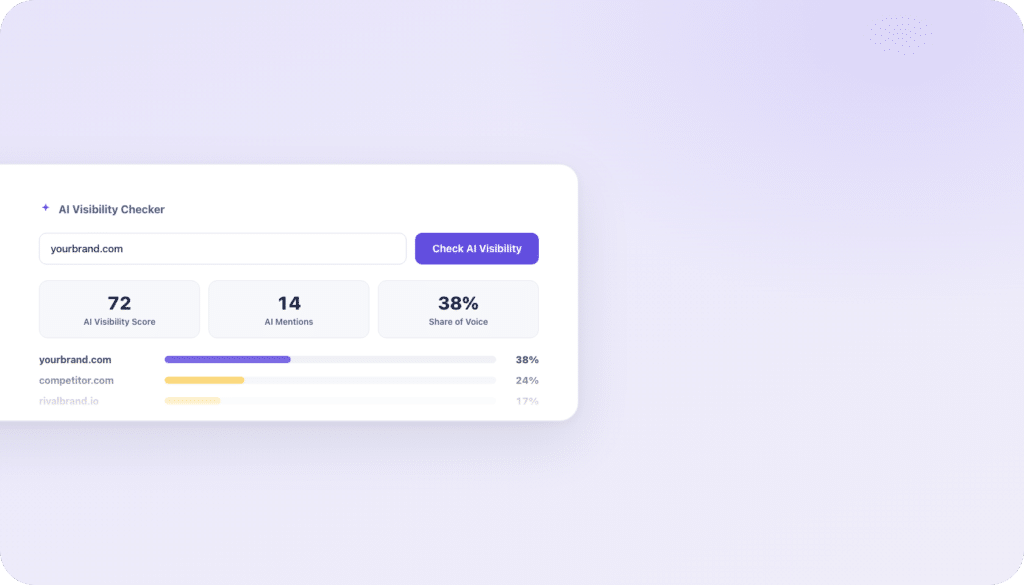
Questions put to an AI assistant are longer, more conversational and more specific than the equivalent Google query, and none of them comes with a volume figure. We collect them separately, find the answers where your brand is missing and write briefs designed to earn citations as well as rankings.

  • Prompt-style questions collected alongside keywords
  • Answers that cite competitors and leave you out
  • +447% AI visibility for Freedom24 over 48 months
Why it matters now

How modern keyword research has changed.

For a long time the process was mechanical. Pull terms from a tool, sort by volume, hand the list over. That model has broken in several places at once. Third-party volume estimates have diverged sharply from real impressions in Search Console. Two keywords with similar volumes can face entirely different competition. AI Overviews take clicks away from informational queries. Forum threads now rank for questions that belonged to trade publishers two years ago. And assistants answer a growing share of questions with no click at all.

A 2026 keyword strategy has to absorb all of that. We combine Ahrefs data with first-party Search Console data, which is closer to ground truth for any keyword you already have some visibility on, then add AI search query research, forum mining for the conversational long tail the tools miss, and a SERP-by-SERP check of what appears for each target query. The deliverable is a framework rather than a flat list, with clusters, intent labels, content type recommendations and the prioritisation logic written down.

All of this matters because a wrong keyword choice carries a cost further down the line. Brief a writer on the wrong intent and a week of editorial time goes on a piece that will not rank. Choose a keyword whose SERP no longer rewards a standard article and the outreach budget goes on links to a page that cannot win. Chase head terms in a niche where Reddit holds the top five and a year passes with nothing to show. Getting the research right first is the cheapest saving available in SEO.

The deliverable

What the deliverable actually looks like.

The output is a connected set of documents rather than a single spreadsheet, and each piece is built to be picked up by the team that owns the next step.

01

Master keyword spreadsheet

One row per keyword. The columns are: keyword, monthly search volume with the source noted, keyword difficulty from Ahrefs, dominant SERP type and features, intent, current ranking page if there is one, recommended target page (existing or new), recommended content type, topical cluster, priority tier and notes. It is filterable, sortable and exportable, so an editor can pull "tier one, new page, comparison format" in seconds.

02

Topical cluster map

A visual map of every cluster showing the pillar page, the supporting articles and how they link to each other. Content teams use it for briefs and developers use it to plan internal linking from the outset.

03

Competitor gap matrix

One sheet per mapped competitor listing the keywords they rank for that you do not, or rank worse for, with traffic potential, difficulty and a score for how feasible each gap is to close.

04

Written strategy summary

A 10 to 20 page document covering the method, the main findings, the recommended content priorities and the 90-day, 180-day and 12-month roadmap. Written for content leads and the board.

05

90-day content priority list

A short action list of the first 30 to 60 pieces of content or page updates to tackle. Each entry links back to its cluster and carries the target keywords, a suggested word count and intent notes, close enough to a brief that your writers can start straight away.

06

Optional content briefs

For an additional fee we produce full briefs per cluster: competitor analysis, recommended structure, suggested H2s, internal linking targets, sources to cite and tone of voice notes. Most clients add briefs for their top 10 to 30. Our guide to on-page SEO factors explains what the briefs check for.

Our specialism

SEO for your industry.

Our SEO services suit most businesses, from SaaS, fintech and eCommerce to finance, legal, crypto and marketing. We’ve helped fintechs, law firms, cryptocurrency exchanges and software providers grow organic traffic, gain powerful backlinks and win top positions in search.

FintechSaaSCrypto and forexFinance and investingInsuranceHR and recruitmentEORLaw firms and legaleCommerceHealth and medicalReal estateConstructionAccountingConsultingRetail and hospitalityTravelAutomotivePublic sector

Case studies

Results, on the record.

Organic traffic, keywords, backlinks, brand mentions and AI visibility, from the first month to the latest report.

Link building · Digital PR · 48 months+2,150%organic traffic for Freedom24
Backlinks gained
1,000+
Brand mentions
520+
AI visibility
+447%
Organic keywords
+1,150%
Monthly organic trafficRead the case study
020k40k60k80k20222023202472.6k / month

Source: Ahrefs organic traffic estimate, Feb 2021 – Oct 2024.

Organic keywords1,000 → 12,500
Familiar to millions

Read across the web.

Our SEO services have seen clients featured in some of the most prominent publications in the world. Links and brand mentions on sites like these are what move rankings in Google and visibility in AI search.


New York PostNewsweekBusiness InsiderNasdaqForbesHubSpotVentureBeat logoEntrepreneurKiplinger logoFinancial Express logo
HubSpotVentureBeat logoEntrepreneurKiplinger logoFinancial Express logoTechRadar logoUSNewsInvestorPlaceYahoo NewsIndependent
TechRadar logoUSNewsInvestorPlaceYahoo NewsIndependentEnvatoZapier logoShopify logoAdweek logoNew York Post
EnvatoZapier logoShopify logoAdweek logoNew York PostNewsweekBusiness InsiderNasdaqForbesHubSpot
Pricing

Keyword research pricing.

Keyword research is included in every Solvid SEO retainer, which starts at £2,500 a month ($3,250) on a six month minimum term with a one-off onboarding fee of 20% of the first month. Standalone keyword research projects start in the low four figures and are quoted on site size, number of competitors and whether you want cluster briefs added.

ConquerorPOPULAR
£7,500/month

Go-for option for businesses with bold outranking plans for their competition. Ideal for competitive industries, medium-sized businesses and eCommerce stores.

Hours
66–84 hours per month
One-off fee
£1,500
Commitment
6 months minimum
  • On-Page SEO
  • Off-Page SEO
  • Technical SEO
  • Content Marketing
  • Digital PR
  • Thought Leadership
  • 12+ DR50+ Links/Month
  • AI and LLM Visibility
  • Backlink audit
  • Content audit
  • Internal content
  • Keyword research
  • Competitor analysis
  • Analytics and reporting
CustomTailored
Custom

Not sure which SEO package you need? Get in touch for a tailored SEO service. Whether you're a small start-up in a unique niche or an S&P 500 company, we'll have an SEO solution for you.

  • On-Page SEO
  • Off-Page SEO
  • Technical SEO
  • Content Marketing
  • Digital PR
  • Thought Leadership
  • Custom DR50+ Links/Month
  • AI and LLM Visibility
  • Backlink audit
  • Content audit
  • Internal content
  • Keyword research
  • Competitor analysis
  • Analytics and reporting
  • 6 months minimum commitment

Prices per month, plus VAT. Fully managed campaigns start at £2,500 ($3,250) a month with a minimum commitment of six months.

Comparison

Solvid vs a typical SEO company.

Choosing an SEO agency in the UK? Here’s how our SEO services compare with what most agencies offer, side by side.

What matters
Typical SEO agency
Years in business
You can never beat experience
11+
Doing SEO since 2015
4
Average age of an SEO agency
Link building
Links still move rankings
In-house
100,000+ links placed
Outsourced
Often resold from link sellers
Content
Content is half of SEO
In-house
2M+ keywords ranked
Freelancers
Quality varies
AI search
Where your buyers now search
Tracked
ChatGPT, Gemini, Perplexity, AI Overviews
Rankings only
AI visibility not measured
Reporting
Transparency builds trust
Live portal
Plus monthly SEO and content reports
Monthly PDF
Little visibility in between
Happy customers
Customer satisfaction is a key principle
100+
Customers happy with Solvid
Minimal
Only a handful
Customer retention
You’re only as good as your retention
24+ months
Retention of 2+ years
8 months
Retention of only 8 months
Locations
Global reach shows ambition
International
Based in the UK and USA
Local-only
Often a single city
Our team

The people behind the results.

Professional SEOs, content strategists, writers and link builders who work together on every campaign, led by founder Dmytro Spilka.

  • Dmytro Spilka, Founder at Solvid
    Dmytro Spilka
    Founder
  • Rebecca Smith, Content & SEO at Solvid
    Rebecca Smith
    Content & SEO
  • Heather Langley, Content & SEO at Solvid
    Heather Langley
    Content & SEO
  • Peter Jobes, Content & SEO at Solvid
    Peter Jobes
    Content & SEO
  • Arsen, Outreach at Solvid
    Arsen
    Outreach
  • Neve Wilkinson, Content at Solvid
    Neve Wilkinson
    Content
  • Gregory, Content at Solvid
    Gregory
    Content
  • Stefan, Content at Solvid
    Stefan
    Content
International reach

Based in London and Los Angeles.
Ranking brands worldwide.

Clients across the UK, the US, Canada, Europe and Australia, and coverage in publications read around the world.

London · HQ
6 St. Davids Square, E14 3WA
Los Angeles
9100 Wilshire Blvd, Beverly Hills

Clients in the United Kingdom, United States, Canada, Spain, Germany, the Netherlands, Cyprus, Switzerland, France and Australia.

SEO services near you.
United Kingdom
Run from our London office, with local SEO for cities across the UK.
United States
Run from our Beverly Hills office in Los Angeles. See all USA SEO services.
Free SEO tools

Start with a free check.

All free tools
Insights

Latest SEO tips.

All articles

Contact

Get the plan that decides everything else

Tell us about your goals and a senior specialist will get back to you.

  • You will speak to a senior specialist,
    not a sales rep.
London
6 St. Davids Square, E14 3WA
020 7072 8788
Los Angeles
9100 Wilshire Blvd, Suite 333
Beverly Hills, CA 90212
Solvid enquiry form
Consent
Newsletter

FAQ

Questions, answered.

Not sure where to start? Book a call and we will review your site and your AI visibility with you.Get started

A master spreadsheet with one row per keyword: search volume with the source noted, keyword difficulty, intent, dominant SERP features, current ranking page, mapped target page, recommended content type, topical cluster and priority tier. You also get a cluster map, a competitor gap matrix, a written strategy summary and a 90-day content priority list.

Get found in Google.
Get recommended by AI.